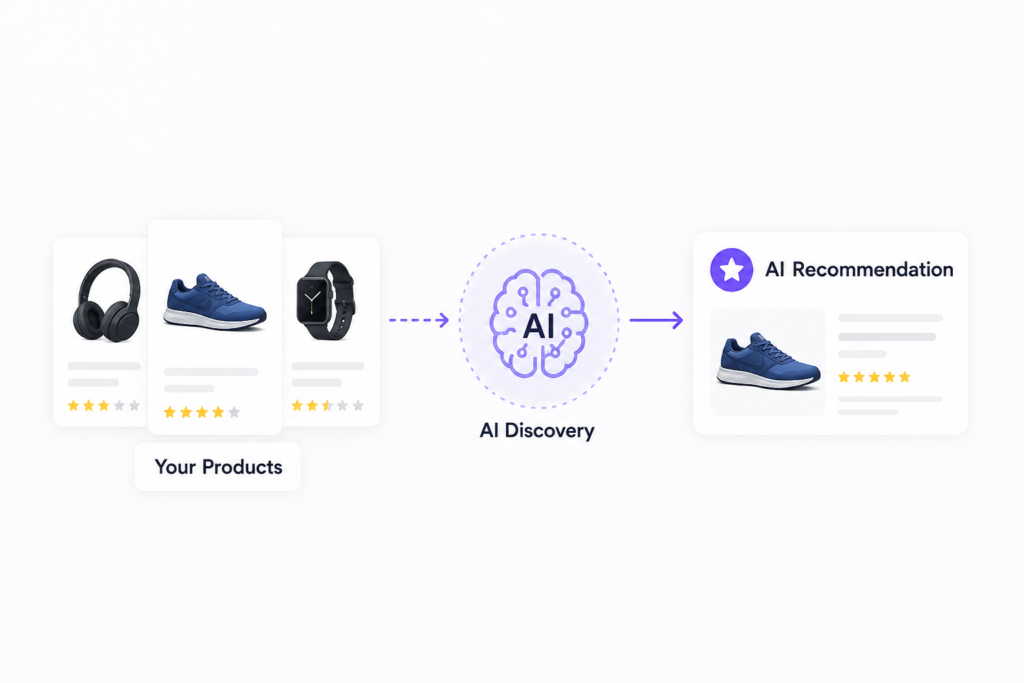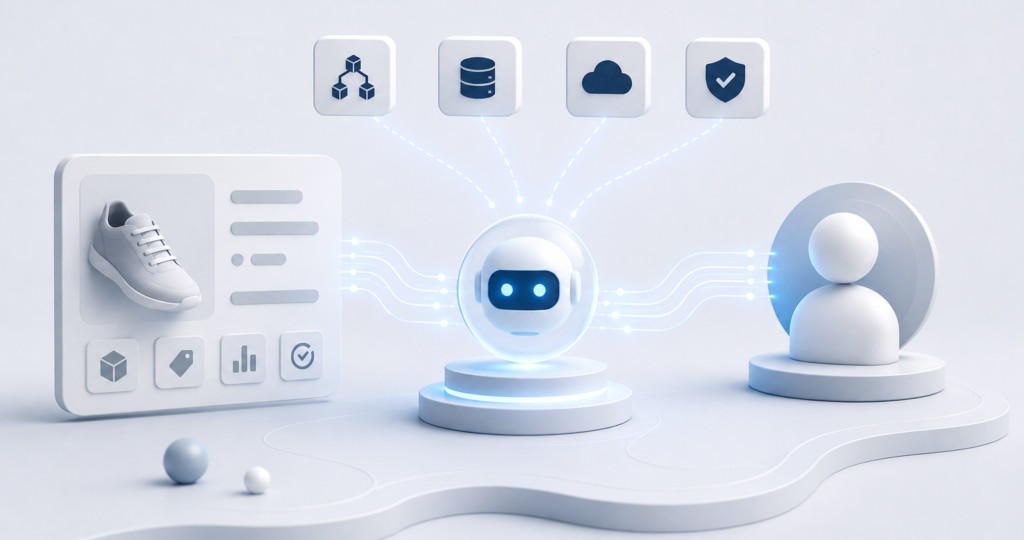
Your Product Catalog Has a New Audience: AI
Traditional ecommerce experiences were built around people navigating categories and typing keywords into a search bar. AI changes that paradigm entirely.
Whether it’s ChatGPT, Google AI Mode, Perplexity, or enterprise procurement copilots, these systems don’t “search” product catalogs—they retrieve, interpret, reason, and rank product knowledge before generating a recommendation.
That distinction matters.
A catalog optimized for keyword search answers “What products contain these words?”
A catalog optimized for semantic retrieval answers “Which product best satisfies this intent?”
The infrastructure required to answer those two questions is fundamentally different.
Why Traditional Product Catalogs Break Down
A conventional catalog treats every product as an isolated record
- SKU
- Name
- Description
- Specifications
- Category
- Brand
While this works well for lexical search, it provides very little context for an AI retrieval pipeline.
Consider the query:
“Looking for a low-noise brake pad compatible with a 2022 Toyota Camry for daily city driving.”
A keyword engine searches for overlapping terms.
A semantic retrieval system decomposes the request into multiple entities and relationships.
Intent
↓
Replacement Part
Vehicle
↓
Toyota Camry (2022)
Component
↓
Brake Pad
Preference
↓
Low Noise
Use Case
↓
Daily Commute
Possible Alternatives
↓
Ceramic Pads
The challenge is no longer matching text—it’s understanding meaning.
How Semantic Retrieval Actually Works
Unlike keyword search, semantic retrieval transforms both the query and the product catalog into mathematical representations known as vector embeddings.
An embedding model encodes semantic meaning into a high-dimensional vector space, positioning products with similar intent closer together—even when they share few or no keywords.
Instead of matching strings, the retrieval engine performs Approximate Nearest Neighbor (ANN) search across this vector index to identify semantically similar products.
A simplified retrieval pipeline looks like this:
User Query
│
Embedding Model
│
Vector Representation
│
ANN Vector Search
│
Candidate Products
│
Metadata Filters
│
Knowledge Graph Traversal
│
Re-ranking
│
LLM Response
Each stage progressively refines the result set rather than relying on a single keyword lookup.
A simplified retrieval pipeline looks like this:
Step 1: Semantic Encoding
The query
“Brake pads that reduce road noise for a 2022 Camry.”
isn’t treated as a sentence.
It’s transformed into a semantic representation capturing concepts such as:
- Product Type
- Vehicle Compatibility
- Functional Intent
- Performance Characteristics
- Context of Use
Similarly, every product in the catalog is pre-embedded using the same model, allowing the engine to compare meaning, not text.
Step 2: Vector Retrieval
The vector database retrieves the nearest product embeddings based on semantic similarity.
This means products can be surfaced even if the description never explicitly contains phrases like “reduce road noise.”
For example:
Product Description:
- Premium Ceramic Brake Pads.
- Excellent thermal stability.
- Low vibration.
- Superior NVH characteristics.
A lexical engine may never associate NVH (Noise, Vibration, Harshness) with quiet braking.
A semantic model understands they’re closely related concepts because they occupy nearby regions in embedding space.
Step 3: Metadata Filtering
Vector similarity alone isn’t enough.
Enterprise commerce requires deterministic constraints.
The candidate set is filtered using structured metadata:
- Vehicle Compatibility
- Model Year
- Inventory Status
- Region
- Supplier
- Regulatory Compliance
This prevents semantically relevant—but operationally invalid—products from reaching the final response.
Step 4: Knowledge Graph Traversal (Where PIM Becomes the Semantic Layer)
This is where many AI initiatives fail.
Most organizations treat the PIM as a repository of product attributes.
In an AI-native architecture, the PIM should instead function as the enterprise product knowledge graph.
Rather than storing isolated records, it models relationships such as:
1) Brake Pad
│
Compatible With
│
Toyota Camry (2022)
2) Brake Pad
│
Uses Material
│
Ceramic
3) Brake Pad
│
Replaces
│
OEM Part 04465-06A90
4) Brake Pad
│
Requires
│
Installation Kit
5) Brake Pad
│
Alternative To
│
Semi-Metallic Variant
Once vector retrieval identifies likely candidates, the retrieval engine traverses these relationships to enrich the response with compatibility, substitutions, cross-sells, prerequisites, and contextual knowledge.
This is the difference between retrieving products and retrieving product intelligence.
Without this connected graph, the LLM can only infer from descriptive text. With it, the model is grounded in explicit enterprise knowledge.
Step 5: Re-ranking and Grounding
The initial retrieval may return dozens of relevant products.
A re-ranking model evaluates them using additional signals, including:
- Semantic similarity
- Product completeness
- Compatibility confidence
- Business rules
- User intent
- Historical engagement
Only then is the final context passed to the LLM.
The language model is no longer generating answers from its own knowledge—it is generating responses grounded in your product knowledge.
This is the foundation of Retrieval-Augmented Generation (RAG) for commerce.
Preparing Product Data for AI Discovery
As AI becomes the primary interface for product discovery, organizations should focus on strengthening the semantic foundation of their product data:
- Standardize product taxonomies and attribute models across catalogs.
- Normalize supplier and manufacturer data into a common semantic model.
- Capture compatibility, substitution, and accessory relationships within the PIM.
- Generate high-quality embeddings from enriched product data.
- Continuously validate retrieval quality through semantic evaluation rather than keyword accuracy.
The objective isn’t a larger catalog—it’s a catalog that AI can reason over with confidence.
How StrikeTru Helps
At StrikeTru, we help enterprises transform fragmented product information into AI-ready semantic infrastructure.
- Assess semantic readiness across existing catalogs.
- Engineer domain-specific taxonomies and ontology-driven data models.
- Transform the PIM into a connected product knowledge graph that powers semantic retrieval.
- Enrich product relationships, compatibility data, and technical metadata for high-quality embeddings.
- Build AI-ready discovery frameworks that improve semantic search, conversational commerce, and agentic buying experiences.
We don’t just improve product data quality—we engineer the knowledge layer that AI systems depend on to retrieve, reason, and recommend with confidence.
Conclusion
AI doesn’t understand products because they’re well-written. It understands products because they’re well-structured, semantically connected, and grounded in machine-readable knowledge.
As commerce shifts from keyword search to semantic retrieval, the competitive advantage will belong to organizations that treat product data as infrastructure—not content. That’s the transformation StrikeTru helps enterprises deliver.