Your Products May Be Searchable. But Are They Recommendable?
For years, ecommerce visibility was largely an SEO problem.
If your products ranked well, customers could find them.
Today, product discovery is changing.
Customers are increasingly asking AI assistants like ChatGPT, Gemini, and Perplexity what to buy instead of browsing pages of search results. And unlike search engines, AI doesn’t show hundreds of options.
It recommends a few.
For merchants, this creates a new visibility challenge.
The question is no longer:
“Can customers find my products?”
It’s:
“Will AI recommend my products when customers ask?”
The merchants that succeed in AI-driven discovery won’t necessarily be the ones with the biggest marketing budgets. They’ll be the ones that provide AI with the clearest understanding of their products.
That means investing in:
- Rich product data
- Detailed product attributes
- FAQs, HowTos, and buying guides
- Customer reviews
- Product comparisons
- Consistent information across channels
Because before AI can recommend a product, it has to understand it.
Why AI Discoverability Matters
AI is rapidly becoming a new product discovery channel.
When customers ask ChatGPT, Gemini, or other AI assistants for product recommendations, they are often presented with only a handful of options instead of pages of search results.
For merchants, this creates a new challenge.
It’s no longer enough for products to be searchable. Products must also be understandable, trustworthy, and recommendable by AI systems.
Unlike traditional search, where paid ads and rankings can drive visibility, AI recommendations are heavily influenced by product information, reviews, supporting content, and third-party validation.
As AI-assisted shopping continues to evolve, merchants that invest in rich product data, strong product content, and digital credibility will be more likely to appear in AI-generated recommendations and buying decisions.
ChatGPT Shopping is a discovery surface, not a search engine. You don’t win by being the brand someone searches for. You win by showing up in the consideration set when users are still in discovery mode.”
How Merchants Can Improve AI Discoverability
Rich Product Data Drives Discoverability
- AI can only recommend products it understands.
- Detailed attributes, specifications, compatibility information, dimensions, materials, and use cases help AI connect products to customer needs.
- This often includes optimizing product attributes, taxonomy, metadata, and supporting content so AI systems can accurately interpret product information.
Go Beyond Product Descriptions
- Customers don’t ask AI for specifications.
- They ask questions.
- Which air fryer is easiest to clean?
- Which running shoe is best for beginners?
- Which laptop is best for engineering students?
- FAQs, buying guides, comparison pages, and how-to content provide the context AI needs to answer these questions and recommend relevant products.
Reviews Matter More Than Ratings
- A five-star rating provides limited context.
- A detailed review explaining how a product solved a problem provides AI with far more useful information.
- Reviews are increasingly becoming a source of product intelligence, helping AI understand real-world use cases, performance, and customer sentiment.
Consistency Builds Trust
- AI gathers information from websites, marketplaces, review platforms, retailer networks, and third-party sources.
- Consistent product information across channels helps reinforce trust and improves recommendation accuracy.
Product Intelligence Is Becoming a Competitive Advantage
The products most likely to be recommended are often supported by more than just product data.
They are supported by product intelligence:
- Product attributes
- Specifications
- FAQs
- Reviews
- Buying guides
- Comparison content
- Supporting documentation
Together, these assets help AI understand what a product is, who it is for, and when it should be recommended.
What is AI Discoverability (AI Product Discoverability)?
AI Product Discoverability is a product’s ability to be found, understood, trusted, and recommended by AI systems. Improving AI Discoverability often requires a combination of product data optimization, AI-ready content, structured data, and strong digital visibility across channels.
For merchants, AI Discoverability comes down to one question:
When AI generates recommendations in your category, are your products part of the answer?
If not, the issue is often not product quality. It’s a lack of product context, credibility, or supporting information.
SEO vs AI Discoverability
| Traditional SEO | AI Discoverability |
|---|---|
| Optimizes for search engines | Optimizes for AI systems |
| Focuses on keywords | Focuses on context and understanding |
| Drives clicks | Drives recommendations |
| Measures rankings and traffic | Measures inclusion in AI answers |
SEO helps search engines find your content.
AI Discoverability helps AI systems understand your products.
AI Identity: What AI Thinks Your Brand Stands For
One of the most overlooked aspects of AI Discoverability is AI Identity.
AI doesn’t define your brand based solely on your website or marketing copy.
It develops an understanding of your brand from reviews, articles, forums, buying guides, expert recommendations, and customer conversations.
Over time, patterns emerge.
Volvo is associated with safety.
Patagonia is associated with sustainability.
Dyson is associated with innovation.
These associations influence recommendations.
The important takeaway for merchants is that AI Identity is shaped less by what brands say about themselves and more by what others consistently say about them.
Customer reviews, industry coverage, educational content, and third-party validation all contribute to the attributes AI associates with your brand.
GEO Starts with Product Intelligence
Generative Engine Optimization (GEO) and AI Search Optimization are often described as the next evolution of traditional SEO.
But unlike traditional SEO, GEO depends heavily on the quality, completeness, and consistency of product information.
You cannot optimize information that doesn’t exist.
The foundation of AI Discoverability is accurate product data, enriched content, structured information, AI-ready content, product feed optimization, brand identity online, and strong governance across channels.
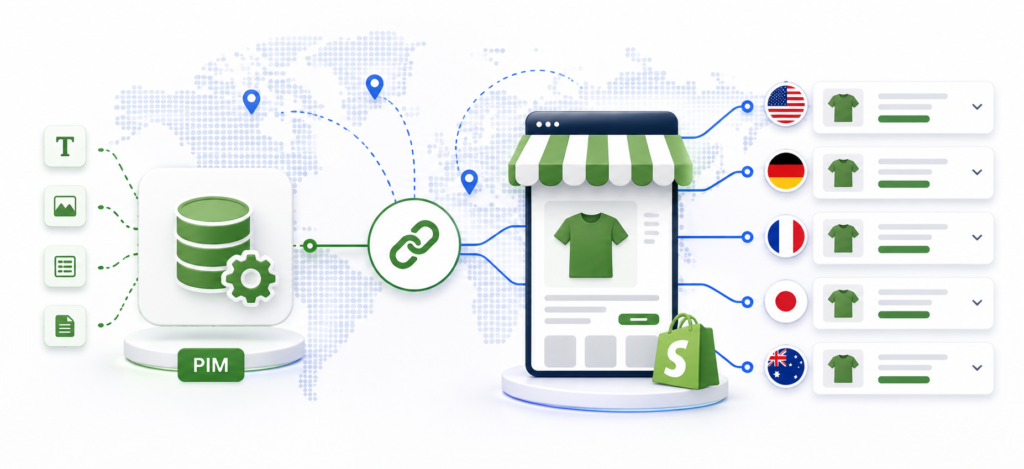
This is why capabilities such as content/catalog management, product enrichment, and data governance which are enabled by Product Information Management (PIM) tool are becoming increasingly important.
As AI becomes a larger part of the buying journey, the merchants best positioned to win visibility will be those that treat product information as a strategic asset rather than a catalog requirement.
Building an AI Discoverability Strategy
Improving AI Discoverability requires more than publishing additional content.
Organizations should focus on:
- Product data quality and enrichment
- Structured product information
- AI-ready content and FAQs
- Product feed optimization
- Schema and metadata enhancements
- Consistent information across channels
- Ratings and reviews
Together, these capabilities help AI systems better understand, evaluate, and recommend products.
For organizations looking to assess their AI readiness, StrikeTru offers a complimentary AI Discoverability Assessment. Our team evaluates product data, content, catalog structure, and digital visibility to identify opportunities for improving AI-powered product discovery and recommendations.
Conclusion
AI is becoming the new front door to product discovery.
The products most likely to be recommended are not necessarily the products with the largest advertising budgets. They are the products AI understands best.
For merchants, improving AI Discoverability starts with strengthening the foundation: richer product data, AI-ready content, structured information, stronger reviews, optimized product feeds, and consistent information across every channel.
The merchants that invest in AI-ready product data today will be best positioned to win visibility, recommendations, and future AI-driven commerce opportunities.