Expanding into new markets is easy. Managing product information across those markets isn't.
Selling internationally has never been more accessible.
With Shopify Markets, merchants can reach customers in multiple countries from a single commerce platform while delivering localized shopping experiences tailored to each region.
The challenge begins after expansion.
Every new market introduces additional product information to manage. Product descriptions require translation. Specifications may differ by region. Measurements change. SEO content needs localization. Regulatory requirements vary between countries. Marketing teams often want market-specific messaging, imagery, and merchandising.
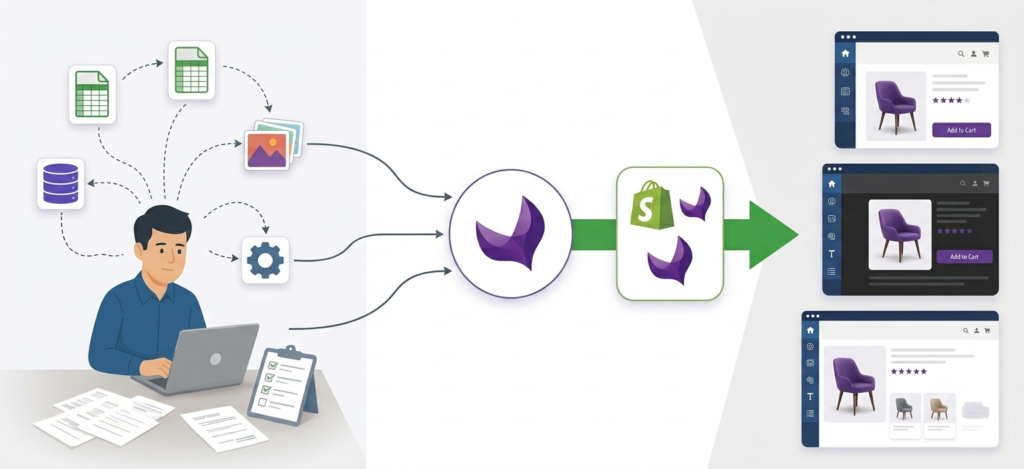
Without a structured approach, product information quickly becomes fragmented, making it increasingly difficult to deliver consistent experiences across every market.
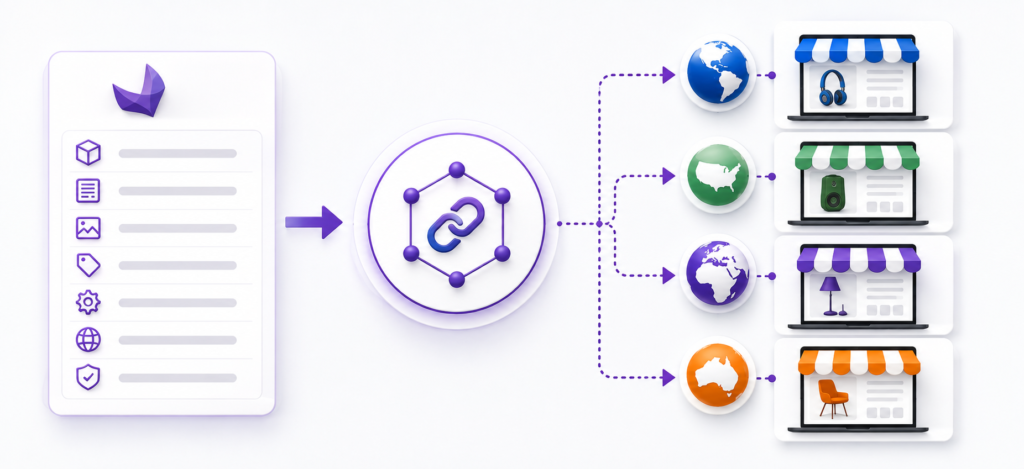
A Shopify PIM connector helps solve this challenge by synchronizing localized product information from a centralized Product Information Management (PIM) system into Shopify, giving merchants a scalable way to manage global product content.
Localization Goes Beyond Translation
Translation is only one part of localization.
Customers in different markets expect product information that reflects their language, regional standards, and purchasing expectations.
Localized product information may include:
- Product names
- Product descriptions
- Marketing copy
- SEO titles and meta descriptions
- Product attributes
- Measurements and units
- Product imagery
- Technical documentation
- Compliance information
- Downloadable assets
Simply translating text rarely creates a localized buying experience.
Effective localization ensures product information feels native to every market while remaining consistent with the brand.
Every New Market Adds Product Complexity
Launching in one additional country may seem straightforward.
Launching in ten is significantly different.
A single product may require:
- English content for the United States
- French content for Canada
- German content for Germany
- Spanish content for Spain
- Different technical specifications
- Region-specific compliance information
- Localized product downloads
- Market-specific imagery
Multiply these requirements across thousands of products, and managing localized content directly within Shopify becomes increasingly difficult.
The challenge isn’t expanding internationally.
It’s maintaining consistent product information as every market introduces new requirements.
Keep Regional Product Information Organized
Global commerce often requires product information that varies by market.
Organizations frequently manage:
- Regional product attributes
- Country-specific product specifications
- Local compliance documentation
- Market-specific downloads
- Regional product imagery
- Localized marketing content
- Measurement conversions
Without centralized governance, these variations are often stored in separate spreadsheets, shared folders, or disconnected business systems.
A Product Information Management platform provides a structured way to manage regional variations while maintaining a consistent product model across every market.
This allows teams to localize product information without creating duplicate product records or disconnected workflows.
Support Shopify Markets with a Centralized Content Strategy
Shopify Markets provides the infrastructure for international commerce.
A Shopify PIM connector ensures each market receives the correct product information.
Instead of maintaining separate versions of products inside Shopify, merchants manage localized content centrally within their PIM while approved market-specific information is synchronized automatically.
This approach reduces administrative effort while improving consistency across every localized storefront.
As new markets are introduced, organizations can extend existing product information rather than rebuilding product content from scratch.
Maintain Consistent Brand Experiences Across Markets
Customers expect more than translated product descriptions.Manual publishing often depends on someone’s availability.
They expect complete, accurate, and locally relevant product information.
Whether a customer shops in Australia, Germany, Canada, or the United Kingdom, the experience should reflect local expectations while remaining consistent with the overall brand.
Centralized localization makes this possible.
Product messaging, imagery, specifications, and supporting content remain aligned across every market while allowing appropriate regional variation where needed.
The result is a global commerce experience that feels local without sacrificing brand consistency.
Manual Localization vs. Centralized Localization
| Manual Localization | Shopify PIM Connector |
| Separate product updates by market | Centralized localization management |
| Multiple translation files | One managed source of localized content |
| Manual regional updates | Automated synchronization |
| Duplicate product records | Shared product structure |
| Inconsistent regional content | Governed localized experiences |
| Higher maintenance effort | Simplified global product management |
Best Practices for Managing Localized Product Information
Organizations supporting multiple markets typically benefit from a structured localization strategy.
Best practices include:
- Maintain one trusted source for product information.
- Store localized content centrally.
- Standardize regional product attributes.
- Keep translations aligned with product updates.
- Manage regional media assets alongside product content.
- Synchronize approved localized information automatically.
- Review localized SEO content regularly.
Together, these practices simplify localization while helping maintain consistent product experiences across every market.
How StrikeTru Helps Global Commerce Teams
At StrikeTru, we help manufacturers, distributors, wholesalers, and retailers simplify global product management through purpose-built Shopify connectors for leading PIM platforms.
Our connectors help organizations centralize multilingual product information, manage regional product variations, support Shopify Markets, and synchronize localized content with Shopify efficiently.
Rather than maintaining separate product management processes for every country, businesses gain a centralized product information foundation that supports international growth while reducing operational complexity.
Final Thoughts
International commerce doesn’t become more complex because of additional storefronts.
It becomes more complex because every new market introduces new product information to manage.
Languages, specifications, imagery, compliance requirements, SEO content, and merchandising all evolve as businesses expand globally.
A Shopify PIM connector helps organizations manage that complexity by centralizing localized product information and synchronizing approved content with Shopify Markets.