Publishing product data isn't the same as managing product data.
Keeping product information accurate is only part of the challenge.
The other challenge is getting approved product updates into Shopify consistently, efficiently, and without disrupting the storefront.
Every ecommerce business publishes product updates.
New products are launched. Existing products are enriched. Pricing changes. Images are replaced. Categories evolve. Product attributes expand.
As catalogs grow, these updates become more frequent and significantly more complex.
The challenge isn’t creating product information. It’s ensuring every approved change reaches Shopify accurately, completely, and at the right time.
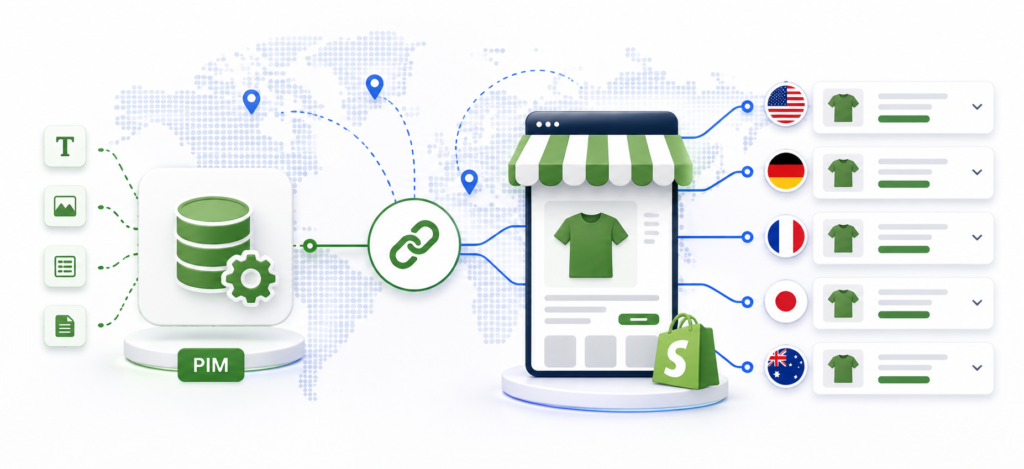
A Shopify PIM connector simplifies this process by automating product publishing from a trusted Product Information Management (PIM) system, replacing manual imports with a structured publishing workflow.
Why Product Publishing Becomes More Complex Over Time
Publishing a handful of products manually is relatively straightforward.
Publishing thousands of products across an evolving catalog is not.
Each update may involve:
- Product titles
- Descriptions
- Images
- Variants
- Categories
- Product attributes
- SEO metadata
- Product relationships
Publishing isn’t simply importing data into Shopify.
Every update must preserve data integrity while ensuring only approved information reaches the storefront.
As the volume of updates increases, manual publishing becomes increasingly difficult to manage reliably.
Bulk Publishing Requires More Than CSV Imports
CSV imports are useful for occasional catalog updates.
Large catalogs, however, often require frequent publishing activities involving hundreds or thousands of products.
Examples include:
- Seasonal catalog launches
- Supplier catalog updates
- Product enrichment projects
- Pricing revisions
- Category restructures
- Brand refreshes
- New product introductions
Managing these changes through manual imports quickly becomes time-consuming and difficult to validate.
As publishing frequency increases, organizations need repeatable processes rather than repetitive tasks.
Validation Should Happen Before Publishing
Publishing incomplete or inaccurate product information creates unnecessary rework.
Before product information reaches Shopify, organizations should verify that required information has been completed.
Typical validation checks include:
- Required attributes
- Product completeness
- Variant structure
- Product images
- Category assignments
- SEO metadata
- Product status
Finding issues before publication is significantly easier than correcting them after products appear on the storefront.
Validation transforms publishing from a manual activity into a controlled business process.
Publish Only Approved Product Information
Not every product update is ready for customers.
Draft descriptions, incomplete specifications, missing images, or products awaiting internal review shouldn’t appear on the storefront.
A Shopify PIM connector supports controlled publishing by synchronizing only approved product information.
Business users determine when products are ready.
The connector ensures only approved records are published to Shopify.
This creates greater consistency while reducing the likelihood of exposing incomplete or inaccurate product information.
Scheduled Synchronization Improves Consistency
Manual publishing often depends on someone’s availability.
Updates may be delayed because imports haven’t been run, files haven’t been prepared, or multiple teams are coordinating product releases.
Purpose-built Shopify PIM connectors support scheduled synchronization, allowing approved product information to be published automatically based on business requirements.
Routine synchronization reduces manual effort while ensuring Shopify stays aligned with the latest approved product information.
Monitor Every Synchronization
Publishing doesn’t end when synchronization begins.
Teams also need visibility into what happened during the publishing process.
Monitoring synchronization helps identify:
- Successful updates
- Failed records
- Validation failures
- Missing products
- Synchronization errors
- Products requiring attention
Instead of manually reviewing thousands of products, teams can focus only on exceptions that require action.
This improves confidence while making large catalog updates significantly easier to manage.
Reduce Publishing Risk
Every manual publishing process introduces risk.
A missed attribute.
An incomplete import.
A failed image upload.
A product published before approval.
These issues become increasingly difficult to detect as catalogs grow.
A structured publishing process reduces these risks by combining validation, approval, automation, and synchronization into a repeatable workflow.
Instead of relying on manual oversight, organizations establish governance that supports consistent product publishing.
Manual Publishing vs. Automated Publishing
| Manual Publishing | Shopify PIM Connector |
| Spreadsheet imports | Automated synchronization |
| Manual validation | Validation before publishing |
| Individual product updates | Bulk publishing |
| Manual approval tracking | One Controlled publishing workflow |
| Limited visibility | Synchronization reporting |
| Manual issue detection | Automated exception monitoring |
Best Practices for Bulk Product Publishing
Organizations managing large catalogs typically benefit from a structured publishing strategy.
Recommended practices include:
- Maintain one trusted source of product information.
- Validate product records before publishing.
- Publish only approved content.
- Schedule synchronization whenever possible.
- Monitor publishing activity after every synchronization.
- Resolve validation issues before products reach Shopify.
Following these practices improves publishing consistency while reducing operational risk.
How StrikeTru Simplifies Product Publishing
At StrikeTru, we help manufacturers, distributors, wholesalers, and retailers streamline product publishing through purpose-built Shopify connectors for leading PIM platforms.
Our connectors enable organizations to validate product information, synchronize approved updates, automate recurring publishing tasks, and monitor synchronization activity from a reliable integration layer.
Rather than relying on manual imports and repetitive publishing processes, businesses gain a controlled workflow that keeps Shopify synchronized with trusted product information.
Final Thoughts
Publishing product information is more than moving data between systems.
It’s about ensuring every product update is complete, approved, and delivered to Shopify consistently.
As product catalogs grow, manual publishing becomes increasingly difficult to manage without introducing errors, delays, or unnecessary administrative effort.
As product catalogs grow, manual publishing becomes increasingly difficult to manage without introducing errors, delays, or unnecessary administrative effort.
A Shopify PIM connector replaces fragmented publishing processes with a structured workflow built around validation, approval, automation, and monitoring.
The result is a more reliable publishing process that gives product teams confidence that every approved update reaches Shopify accurately and efficiently.