Manual product management doesn't fail overnight. It slowly becomes the bottleneck.
Every ecommerce business starts with simple product management.
A few products are added directly into Shopify. Product descriptions are copied from supplier catalogs. Images are uploaded manually. Product specifications are updated when they change.
For a small catalog, this approach works.
As the business grows, however, the process becomes increasingly difficult to maintain. New suppliers introduce different data formats. Product variants multiply. Marketing teams need richer content. Customers expect complete and accurate product information across every channel.
Before long, managing products becomes less about creating great product experiences and more about keeping multiple systems synchronized.
The problem isn’t Shopify.
The problem is relying on manual processes to manage product information at scale.
Why Manual Product Management Breaks Down
Most merchants don’t intentionally create inefficient product management processes.
They evolve naturally.
Product information begins in supplier spreadsheets.
Pricing comes from the ERP.
Marketing updates descriptions.
Creative teams manage images.
Merchandisers update Shopify.
Customer service maintains additional documentation.
Each department works with the information it needs, often using different tools and different versions of the same product.
Over time, product information becomes fragmented across the organization.
Instead of maintaining one product record, teams spend their time managing multiple versions of the truth.
Spreadsheet Sprawl Is More Expensive Than It Looks
Spreadsheets are incredibly useful.
They’re also one of the biggest reasons product management becomes difficult.
Different teams create different spreadsheets for:
- Supplier data
- Pricing
- Product specifications
- Marketing copy
- Product images
- Category assignments
- Product attributes
Soon there are multiple versions of every product, each updated independently.
Finding the latest spreadsheet becomes part of the workflow.
Updating Shopify becomes another.
Reconciling differences becomes another.
Eventually, spreadsheets stop supporting product management and start controlling it.
Every Product Update Creates More Administrative Work
Product information is constantly changing.
Specifications evolve.
Images are replaced.
Pricing changes.
Descriptions improve.
Products gain new attributes.
Without a structured product information process, every change follows the same repetitive cycle.
Someone identifies the change.
Someone updates a spreadsheet.
Someone copies the information into Shopify.
Someone verifies the update.
Someone fixes mistakes.
Then the process repeats for the next product.
Individually, these tasks appear small.
Across hundreds or thousands of products, they become one of the largest ongoing operational burdens within ecommerce teams.
Multiple Systems Create Multiple Versions of the Truth
Very few organizations manage products in only one system.
A typical commerce ecosystem may include:
- ERP
- Product Information Management (PIM)
- Shopify
- Supplier portals
- Digital Asset Management (DAM)
- Shared spreadsheets
Each system serves a different purpose.
The challenge begins when product information is updated independently within each one.
Over time, inconsistencies become inevitable.
An image is updated in Shopify but not in the PIM.
A specification changes in the ERP but never reaches the storefront.
Marketing revises product copy while supplier information remains outdated
The question stops being “What changed?”
It becomes:
“Which system contains the correct product information?”
Manual Processes Increase the Risk of Human Error
Most product data issues aren’t caused by complex technical failures.
They’re caused by ordinary manual work.
A missed attribute.
An outdated image.
An incorrect specification.
A duplicated SKU.
A pricing discrepancy.
An incomplete product description.
None of these errors are unusual.
The problem is their cumulative impact.
As catalogs expand, identifying and correcting small inconsistencies consumes more time than improving the product experience itself.
Routine Catalog Updates Become IT Projects
As product management becomes more complex, ecommerce teams often rely on developers for routine catalog maintenance.
Common tasks include:
- Bulk imports
- CSV formatting
- Attribute mapping
- Image synchronization
- Data corrections
- Custom scripts
These activities should take only a few minutes. Instead, they require coordination between business users and technical teams.
As a result, catalog management becomes slower, more expensive, and less efficient.
How a Shopify PIM Connector Changes Product Operations
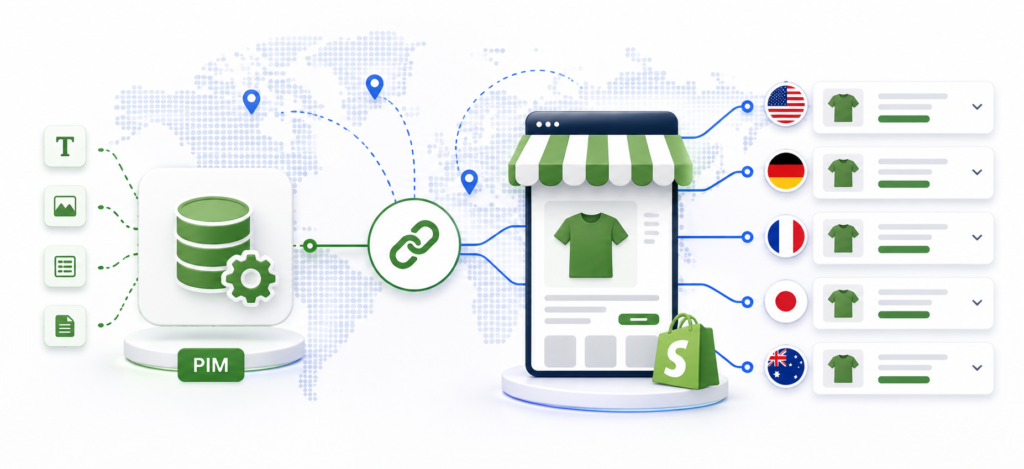
A Shopify PIM connector changes where product information is managed.
Instead of updating products across multiple spreadsheets and business systems, teams maintain information within a centralized Product Information Management (PIM) platform.
Approved product information is then synchronized automatically with Shopify.
This changes the role of product teams.
Instead of spending time copying data, reconciling spreadsheets, and repeating the same administrative tasks, they can focus on enriching product content, improving merchandising, and maintaining product quality.
Automation doesn’t replace product expertise.
It removes the repetitive work that prevents product teams from applying it effectively.
Manual Product Management vs. Connected Product Management
| Manual Product Management | Shopify PIM Connector |
| Product information spread across multiple systems | Centralized product management |
| Multiple spreadsheets | Single source of truth |
| Manual copy-and-paste updates | Automated synchronization |
| Duplicate data entry | One approved product record |
| Manual reconciliation | Consistent product information |
| Frequent IT involvement | Business-managed product updates |
Signs You've Outgrown Manual Product Management
Your current approach may no longer support your business if:
- Product information exists in multiple spreadsheets.
- Teams manually copy information between systems.
- Product updates require frequent CSV imports.
- Different systems contain conflicting product information.
- Catalog updates regularly require IT assistance.
- Maintaining product data consumes more time than improving it.
These aren’t just operational inconveniences. They’re clear signs that your product management process is no longer keeping pace with business growth.
How StrikeTru Simplifies Product Management
At StrikeTru, we help manufacturers, distributors, wholesalers, and retailers replace fragmented product management processes with purpose-built Shopify connectors for leading PIM platforms.
Our connectors help organizations:
- Eliminate duplicate product maintenance
- Reduce spreadsheet-driven workflows
- Synchronize approved product information automatically
- Simplify catalog management
- Improve product data consistency across Shopify
Rather than managing products across disconnected systems, businesses gain a reliable product information foundation that supports day-to-day operations with significantly less administrative effort.
Final Thoughts
Manual product management rarely becomes unsustainable because of one major problem.
It becomes difficult because every new product, supplier, attribute, spreadsheet, and business system adds another layer of administration.
Over time, maintaining product information becomes more difficult than managing the products themselves.
A Shopify PIM connector helps reverse that trend by centralizing product information and automating synchronization with Shopify.
Instead of spending valuable time maintaining disconnected product records, product teams can focus on delivering complete, accurate, and engaging product experiences.