Product information is only as valuable as your ability to use it.
For many ecommerce businesses, investing in a Product Information Management (PIM) system is a logical step. It centralizes product data, improves governance, and creates a single source of truth for product information.
The challenge begins after the PIM is implemented.
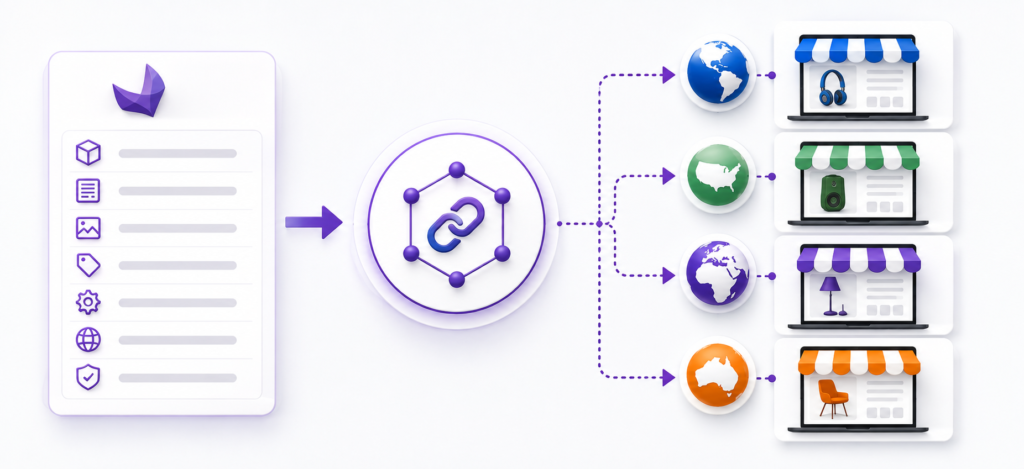
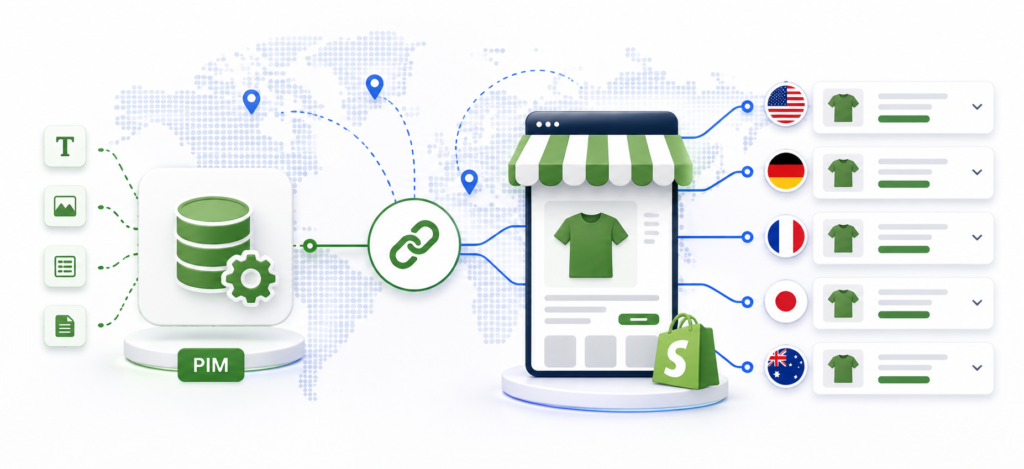
A PIM doesn’t operate in isolation. Product information still needs to reach Shopify accurately, consistently, and without creating additional maintenance work. That’s where a Shopify PIM connector becomes critical.
Many organizations evaluate a connector as a technical integration project—a necessary bridge between two systems. In reality, it’s a long-term technology investment that influences maintenance costs, implementation effort, data quality, and the overall return on a PIM investment.
The real value isn’t measured by how efficiently product information moves between systems. It’s measured by how much complexity the connector removes over the lifetime of your commerce platform.
ROI Is About More Than Implementation Costs
When evaluating a Shopify PIM connector, the first questions are usually financial.
- How much will it cost?
- How long will implementation take?
- Will custom development be required?
These are valid questions, but they only evaluate the initial investment.
The greater cost of any integration comes after implementation.
Every platform upgrade, API enhancement, business requirement, or catalog change has the potential to introduce additional maintenance work. Over time, those ongoing costs often exceed the original implementation effort.
A purpose-built Shopify PIM connector changes that equation by reducing maintenance, simplifying long-term support, and providing a stable integration designed specifically for product information management.
The return isn’t simply faster implementation. It’s lower operational cost over the life of the solution.
Where Merchants Realize the Greatest Return
Lower Integration Maintenance
Custom integrations frequently require ongoing development as APIs evolve and business requirements change.
Purpose-built Shopify PIM connectors reduce that dependency by providing a standardized integration that evolves alongside Shopify and leading PIM platforms.
Instead of continually maintaining custom code, organizations benefit from a supported integration designed for long-term reliability.
Better Product Data Quality
Product information influences nearly every part of the buying experience.
Accurate descriptions, specifications, images, and attributes improve merchandising while creating greater confidence for customers.
Synchronizing approved product information directly from a centralized PIM helps maintain consistent product data across the storefront while reducing discrepancies caused by disconnected systems.
Better data doesn’t simply improve the customer experience—it also reduces the operational effort required to identify and correct inconsistencies.
Reduced Integration Complexity
Modern commerce environments rarely consist of only two systems.
Many organizations connect Shopify with ERP platforms, digital asset management systems, supplier portals, search solutions, marketing platforms, and Product Information Management software.
As integrations increase, so does technical complexity.
Purpose-built connectors simplify this architecture by providing a reliable synchronization layer specifically designed for Shopify product data.
The result is a commerce ecosystem that’s easier to maintain, easier to support, and easier to evolve.
Faster Time-to-Value
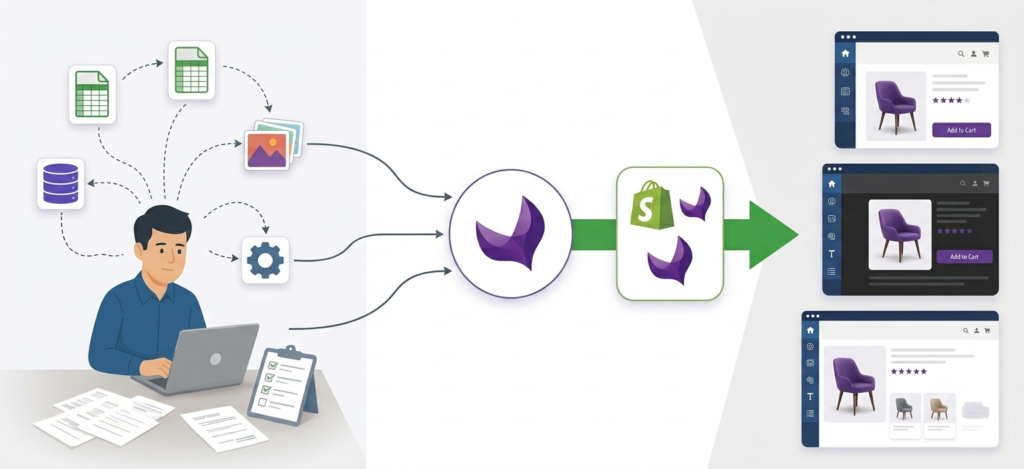
Building a custom integration often involves extensive planning, development, testing, and ongoing refinement before organizations begin realizing measurable value.
Purpose-built connectors accelerate implementation by providing proven synchronization capabilities designed specifically for Shopify.
Rather than investing months building functionality that already exists, businesses can begin benefiting from their Product Information Management investment much sooner.
Lower Total Cost of Ownership
Implementation represents only a fraction of an integration’s total cost.
Developer time, support requests, API updates, bug fixes, monitoring, and long-term maintenance all contribute to the total cost of ownership.
Purpose-built Shopify PIM connectors reduce these recurring costs by minimizing custom development and providing a supported integration that continues evolving alongside the platform.
For many organizations, these long-term savings represent the largest component of overall ROI.
Protecting Technology Investments
Commerce technology is continually evolving.
Organizations introduce new systems, improve digital experiences, expand product catalogs, and refine business processes over time.
A reliable Shopify PIM connector protects these investments by providing a stable integration foundation that adapts to changing business requirements without requiring continual redevelopment.
Rather than rebuilding integrations every time technology evolves, businesses can continue extending the value of their existing commerce ecosystem.
The Hidden Costs of Custom Integrations
Implementation costs are visible.
Long-term maintenance costs often are not.
Organizations frequently underestimate expenses associated with:
- Ongoing integration maintenance
- API changes
- Platform upgrades
- Technical debt
- Repeated redevelopment
- Increased support requirements
Individually, these costs may appear manageable.
Collectively, they can become one of the largest ongoing expenses associated with a commerce platform.
Evaluating a connector solely on implementation cost often overlooks the long-term operational savings it can deliver.
Measuring Long-Term ROI
Every organization measures return on investment differently, but several indicators consistently demonstrate the value of a purpose-built Shopify PIM connector.
These include:
- Integration maintenance hours
- Developer support effort
- Total cost of ownership
- Time-to-value
- Product data consistency
- Integration reliability
Tracking these metrics before and after implementation provides a more accurate picture of long-term business value than implementation cost alone.
Why Purpose-Built Connectors Deliver Greater Long-Term Value
Generic integration platforms provide flexibility, but flexibility often comes with additional configuration, maintenance, and ongoing development.
Purpose-built Shopify PIM connectors take a different approach.
They’re designed specifically to synchronize product information between Shopify and leading Product Information Management platforms, reducing implementation complexity while providing a more maintainable long-term solution.
For organizations seeking predictable costs and reliable synchronization, specialization frequently delivers greater long-term value than customization.
How StrikeTru Helps Organizations Maximize ROI
At StrikeTru, we’ve helped manufacturers, distributors, wholesalers, and retailers implement purpose-built Shopify connectors that simplify product information synchronization while reducing long-term integration overhead.
Our connectors are designed to:
- Lower integration maintenance costs
- Improve product data consistency
- Reduce long-term support effort
- Accelerate implementation
- SCProvide a dependable integration foundation that grows alongside your business
Rather than viewing integration as a one-time project, we help organizations build product information ecosystems that continue delivering value as commerce operations evolve.
Final Thoughts
A Shopify PIM connector is more than an integration between two systems.
It’s an investment in reducing long-term technology costs, simplifying integration management, and protecting the value of your Product Information Management platform.
While implementation cost is often the starting point of evaluation, the greatest return comes from lower maintenance requirements, reduced technical complexity, improved data consistency, and a platform that continues supporting your business as it grows.
Organizations that evaluate a Shopify PIM connector as a long-term technology investment—not simply another integration—are better positioned to maximize the value of both Shopify and their broader commerce ecosystem.