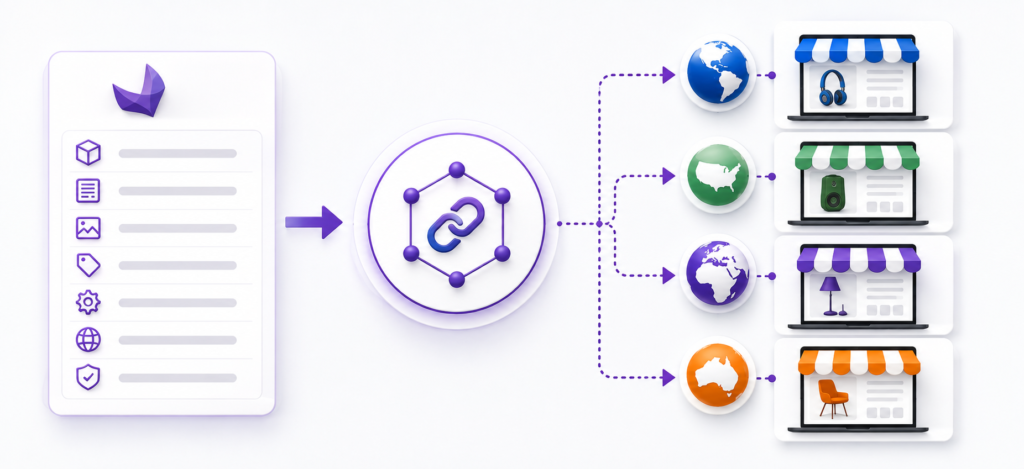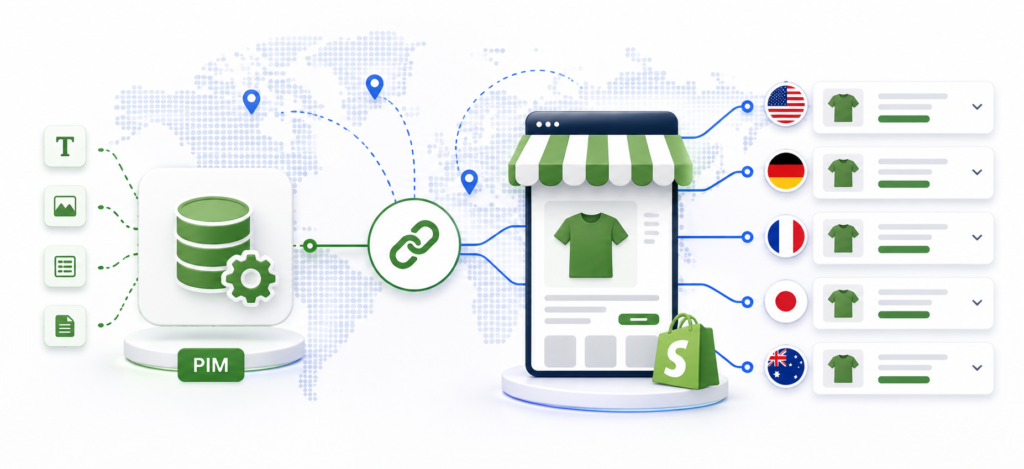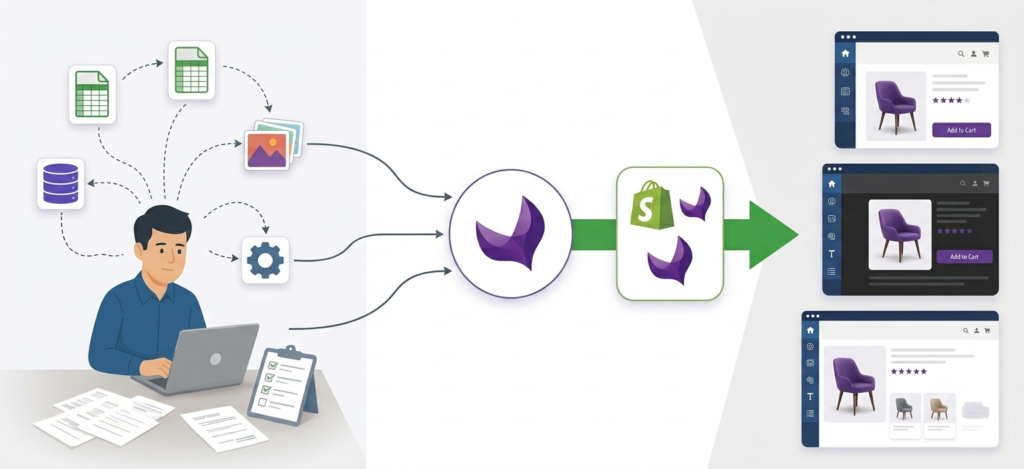
As ecommerce businesses expand their product catalogs, maintaining accurate and consistent product information across systems becomes increasingly complex. Many organizations rely on Akeneo PIM to centralize product information while using Shopify to power their online storefront.
The challenge isn’t deciding whether to integrate the two platforms—it’s deciding how.
Should you build a custom integration? Adopt an enterprise middleware platform? Or implement a purpose-built Shopify connector designed specifically for Akeneo?
Each option can synchronize product information between Akeneo and Shopify, but they differ significantly in implementation effort, maintenance, flexibility, and total cost of ownership.
This guide explores each approach to help you determine the best fit for your business.
Why Integrating Akeneo PIM with Shopify Matters
Akeneo PIM serves as the central repository for product information, while Shopify delivers that information to customers through your ecommerce storefront.
An effective integration ensures product data flows seamlessly from one platform to the other, enabling businesses to:
- Publish products faster
- Maintain consistent product information
- Reduce manual updates
- Improve merchandising efficiency
- Support multilingual catalogs
- Deliver a better customer experience
Without a reliable integration, teams often face:
- Duplicate data entry
- Spreadsheet-based imports and exports
- Product inconsistencies
- Missing images and attributes
- Delayed product launches
- Increased operational costs
Selecting the right integration strategy is essential for maintaining an efficient and scalable commerce operation.
Three Approaches to Akeneo-Shopify Integration
Organizations typically choose one of three methods:
- Custom Integration
- Middleware Platform
- Purpose-Built Shopify Connector
Each offers a different balance of flexibility, complexity, and speed to value.
Option 1: Custom Integration
A custom integration involves developing a dedicated connection between Akeneo and Shopify using their respective APIs.
This approach gives organizations complete control over how product information is synchronized.
Advantages
Complete Flexibility
Custom integrations allow businesses to tailor every aspect of synchronization, including:
- Product publishing
- Attribute mapping
- Variant handling
- Images and digital assets
- Collections
- Shopify metafields
- Localization
- Pricing rules
- Custom workflows
If your business has unique operational requirements, custom development offers maximum flexibility.
Supports Complex Business Logic
Large organizations often require workflows that standard integrations cannot easily support.
Examples include:
- Region-specific product catalogs
- Multi-brand storefronts
- Multiple Shopify stores
- Conditional publishing
- Custom approval processes
- ERP-driven product availability
A custom integration can be designed around these requirements.
Challenges
High Development Investment
Custom integrations require experienced developers familiar with both platforms.
Projects typically involve:
- Solution architecture
- API development
- Testing
- Deployment
- Documentation
Development costs can become substantial, especially for enterprise catalogs.
Longer Implementation Timeline
Unlike ready-made solutions, custom integrations often take weeks or months to design, build, and validate.
This delays time-to-value.
Ongoing Maintenance
Both Shopify and Akeneo regularly update their APIs and platform capabilities.
Organizations must continuously maintain compatibility, address API changes, and resolve issues as business requirements evolve.
Maintenance becomes a long-term responsibility rather than a one-time project.
Best Fit
A custom integration is best suited for organizations that:
- Have highly specialized workflows
- Require complete control over data synchronization
- Operate complex enterprise ecosystems
- Have dedicated internal development resources
Option 2: Middleware Platforms
Middleware platforms act as integration hubs that connect multiple enterprise applications.
Rather than creating direct connections between systems, middleware manages data flows across the technology ecosystem.
Popular integration platforms include:
- Celigo
- Boomi
- MuleSoft
- Workato
- Jitterbit
These solutions support configurable workflows, transformations, and automation.
Advantages
Faster Than Building from Scratch
Many middleware platforms provide prebuilt connectors and templates, reducing development effort.
Organizations configure workflows rather than writing every integration from the ground up.
Connect Multiple Business Systems
Middleware is particularly valuable when integrating systems such as:
- ERP
- CRM
- Warehouse Management
- Marketing Automation
- Ecommerce Platforms
- PIM Solutions
It creates a centralized integration architecture.
Powerful Workflow Automation
Most middleware platforms support:
- Scheduled synchronization
- Data transformation
- Conditional workflows
- Notifications
- Error handling
- Monitoring dashboards
These capabilities simplify enterprise integration management.
Challenges
Higher Licensing Costs
Middleware platforms often charge based on:
- Connected applications
- Transaction volume
- API usage
- Workflow complexity
Costs can increase significantly as businesses grow.
Technical Configuration Still Required
Although middleware platforms are often marketed as low-code solutions, successful implementation typically requires knowledge of:
- APIs
- Data mapping
- Integration design
- Workflow configuration
Technical expertise remains essential.
May Be More Than You Need
If your primary objective is synchronizing Akeneo with Shopify, a full middleware platform may introduce unnecessary complexity.
Many businesses require a simpler, more focused solution.
Best Fit
Middleware is ideal for organizations that:
- Integrate numerous enterprise applications
- Require centralized workflow orchestration
- Already use an enterprise integration platform
- Need broad system connectivity beyond ecommerce
Option 3: Purpose-Built Shopify Connector
Purpose-built connectors are designed specifically to synchronize Akeneo PIM with Shopify.
Rather than serving as generic integration platforms, these connectors focus exclusively on enabling efficient product data synchronization between the two systems.
They typically include preconfigured mappings, Shopify-specific logic, and simplified deployment.
Advantages
Faster Deployment
Because they are purpose-built, connectors can often be implemented in days instead of months.
Most configuration focuses on business rules rather than software development.
Lower Total Cost of Ownership
Purpose-built connectors reduce:
- Development costs
- Maintenance effort
- Testing requirements
- Long-term support expenses
This allows teams to focus on product data rather than integration infrastructure.
Built Specifically for Shopify
Unlike generic integration platforms, dedicated connectors understand Shopify’s product model and commonly support:
- Products
- Variants
- Collections
- Images
- Metafields
- SEO metadata
- Multi-language content
- Product publishing
- Category mapping
These capabilities align closely with Shopify’s commerce workflows.
Vendor-Managed Updates
As Shopify and Akeneo evolve, connector providers typically handle API compatibility, product enhancements, and ongoing maintenance.
Businesses benefit from continuous improvements without maintaining custom integration code.
Accelerated Product Publishing
Marketing and merchandising teams can manage product information within Akeneo while publishing accurate, enriched catalogs to Shopify with minimal manual intervention.
This significantly improves operational efficiency.
Considerations
Purpose-built connectors may be less suitable for organizations requiring:
- Highly customized integration logic
- Complex multi-system orchestration
- Extensive proprietary workflows
However, many modern connectors provide configurable mappings and extension capabilities that accommodate a wide range of business requirements.
Comparing the Three Approaches
| Criteria | Custom Integration | Middleware | Purpose-Built Connector |
|---|---|---|---|
| Implementation Time | Long | Moderate | Fast |
| Initial Investment | High | Medium to High | Low to Medium |
| Maintenance Effort | High | Medium | Low |
| Shopify Optimization | Custom | Moderate | Excellent |
| Scalability | Excellent | Excellent | Excellent |
| Technical Expertise | High | Medium | Low |
| API Management | Internal | Shared | Vendor Managed |
| Time to Value | Slow | Moderate | Fast |
How Should You Decide?
The right integration approach depends on your business goals, existing technology stack, and available resources.
Choose a Custom Integration If:
- Your workflows are highly specialized.
- You need complete control over integration logic.
- You have an experienced development team.
- Long-term customization is a priority.
Choose Middleware If:
- You integrate multiple enterprise applications.
- Workflow orchestration is essential.
- Your organization already uses an integration platform.
- Cross-system automation extends beyond ecommerce.
Choose a Purpose-Built Shopify Connector If:
- Shopify is your primary ecommerce platform.
- You want rapid implementation.
- You want to minimize maintenance.
- You need Shopify-specific capabilities without building custom code.
- You want faster product publishing and lower operational costs.
Key Questions to Ask Before Choosing
Before selecting an integration strategy, consider:
- How many Shopify stores do you manage?
- How frequently does your product catalog change?
- Do you require real-time or scheduled synchronization?
- Will you publish multilingual product content?
- Do you rely on Shopify metafields or custom attributes?
- How much internal development capacity do you have?
- What are your long-term maintenance expectations?
Answering these questions will help align your integration approach with your business objectives.
Why Purpose-Built Connectors Are Becoming the Preferred Choice
As ecommerce operations become increasingly data-driven, businesses are looking for solutions that deliver value quickly without introducing unnecessary complexity.
Purpose-built Shopify connectors provide that balance.
Rather than investing months in custom development or deploying enterprise middleware for a single integration, organizations can implement a solution designed specifically for Akeneo and Shopify.
The result is faster deployment, simplified maintenance, improved data consistency, and a shorter path to business value.
Final Thoughts
Integrating Akeneo PIM with Shopify is no longer just about transferring product data—it’s about creating a scalable product information ecosystem that supports growth, operational efficiency, and exceptional customer experiences.
While custom integrations offer unmatched flexibility and middleware platforms excel in complex enterprise environments, purpose-built Shopify connectors provide the ideal combination of speed, simplicity, and Shopify-focused functionality for many businesses.
At StrikeTru, we believe successful ecommerce integrations should enable teams to focus on managing exceptional product experiences—not maintaining complex integration code. A purpose-built Akeneo-Shopify connector empowers organizations to streamline product publishing, improve catalog accuracy, and scale confidently as their commerce operations evolve.
As digital commerce continues to grow, choosing the right integration strategy today will help ensure your product data remains consistent, reliable, and ready for whatever comes next.