B2B Commerce Is Changing. Are Mid-Market Enterprises Ready?
B2B commerce has moved beyond traditional sales processes built around phone calls, emails, and manual ordering. Today’s buyers expect faster, more digital, and more personalized purchasing experiences.
A new generation of B2B buyers, including Millennials and Gen Z professionals, are bringing consumer-style expectations into business purchasing. Buyers increasingly research independently, compare solutions online, and prefer digital self-service over relying on sales teams for every interaction.
Modern B2B buyers expect:
- Easy access to product information
- Digital purchasing options
- Personalized recommendations
- Faster responses
- Self-service buyer experience
The buying journey is also evolving with AI-powered search. Buyers are increasingly using AI tools to research solutions, compare options, and identify potential suppliers before engaging with sales teams.
The question for mid-market enterprises is no longer:
“Can customers find our products?”
It is:
“Can customers quickly understand, trust, and purchase our products?”
Understanding Modern B2B Commerce
B2B commerce involves businesses selling products or services to other businesses. Unlike B2C commerce, B2B purchasing typically involves larger transactions, complex requirements, multiple decision-makers, and long-term relationships.
For example, manufacturers often work with distributors to expand their reach. Distributors manage inventory, sales, and fulfillment while connecting manufacturers with retailers, contractors, and other business customers.
Because B2B transactions are more complex, businesses need commerce solutions that improve efficiency while supporting relationships across the supply chain.
The New B2B Buyer Experience
The B2B buyer journey now begins before a sales conversation.
Buyers research:
- Products
- Pricing
- Reviews
- Alternatives
- Business solutions
AI-powered search is becoming part of this process, allowing buyers to ask questions and receive recommendations before contacting suppliers.
This creates a new requirement for businesses: product information must be accurate, complete, and easy for both customers and AI systems to understand.
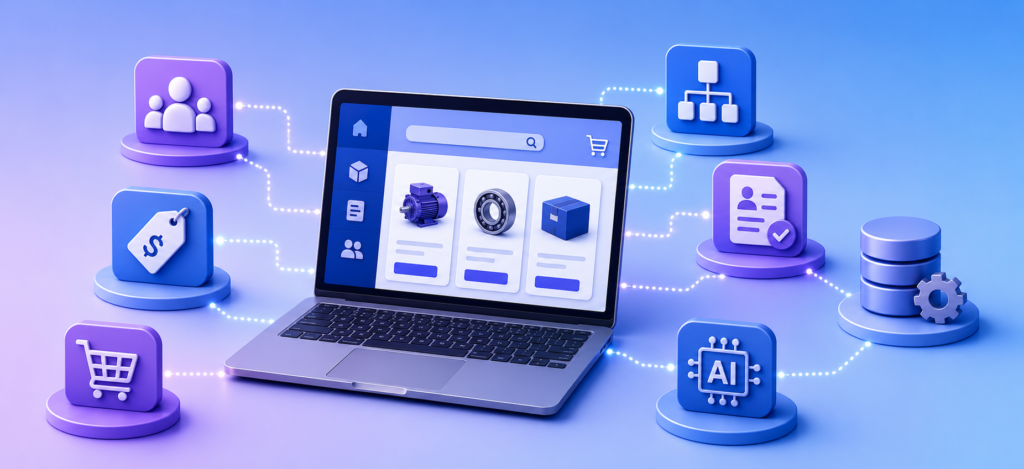
Modern B2B commerce is moving toward:
- Digital storefronts
- AI-powered search & suggestions
- Sophisticated buying workflows
- Self-service buyer portals
Key Trends Shaping B2B Commerce
Self-Service Buying
Customers want control over purchasing. They expect to search products, check availability, place orders, and track shipments without unnecessary delays.
Self-service improves customer experience while allowing sales teams to focus on higher-value opportunities.
Personalization
B2B buyers expect relevant experiences, including:
- Customer-specific catalogs
- Custom pricing
- Recommended products
- Relevant content
- Customized communication
Personalization helps companies build stronger customer relationships and improve retention.
AI and Automation
AI is transforming B2B commerce by improving:
- Product discovery
- Customer support
- Recommendations
- Forecasting
- Sales operations
However, AI depends on strong product data. Businesses need accurate product descriptions, specifications, and digital content to support better experiences.
Challenges for Mid-Market Enterprises
Mid-market companies often face challenges, including:
Legacy systems: Older technology can limit integration between eCommerce, inventory, and customer systems.
Complex pricing: Businesses must support contracts, discounts, and customer-specific pricing.
Digital transformation: Teams must adapt processes and workflows to new technology.
The Future of B2B Commerce
The future of B2B commerce will be shaped by:
- AI-driven experiences
- Digital self-service
- Personalization
- Better product information
- Connected business systems
Companies that succeed will not only sell products; they will create easier, smarter, and more efficient buying experiences.
For mid-market enterprises, digital B2B commerce is becoming a key driver of growth, customer satisfaction, and competitive advantage.