Akeneo announced the deal on June 11, 2026. The press release framing is fairly high-level. Let’s break down what this actually means in practice.
What does PricingHUB do
PricingHUB sits between your product catalog and the market — it pulls in competitor prices, models how demand shifts with price changes, and surfaces or automates pricing decisions at the SKU level.
What a unified PIM + Pricing system looks like architecturally
Right now, for most retailers and brands, the stack looks like this:
- PIM (Akeneo) → manages product attributes, enrichment, syndication
- Pricing tool (separate) → pulls in competitor data, sets rules, pushes prices to commerce platform
- These two systems talk to each other loosely, if at all — usually via exports, feed files, or custom integrations
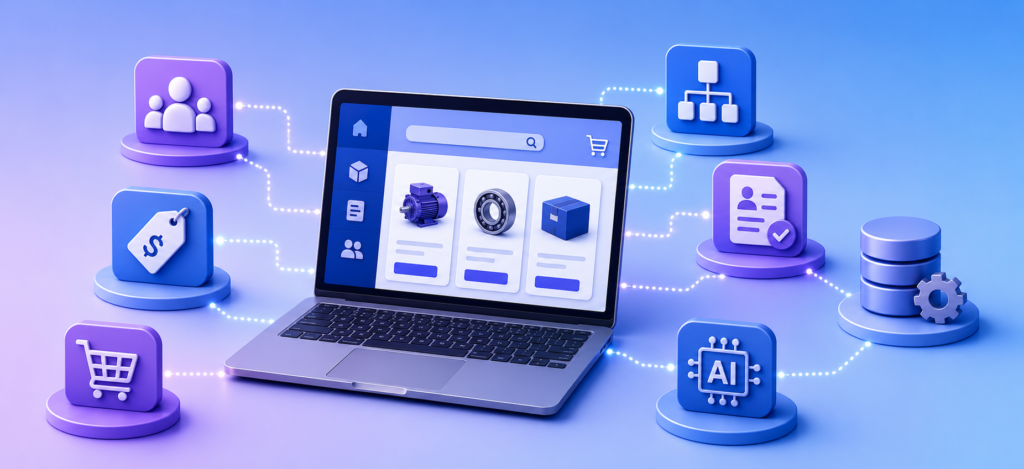
Post-acquisition, the intent would be to collapse that into a single data model where:
- Product attributes (category, specs, images, descriptions) and pricing rules live in the same record
- Price optimization can be context-aware — e.g. a product’s positioning tier, its attribute completeness score, or its channel syndication status can directly inform pricing logic
- Activation (pushing data to channels) carries both enriched content and optimized price simultaneously
The concrete operational changes this would enable
- Assortment-aware pricing — instead of pricing SKUs in isolation, the system understands how a product sits within a category hierarchy and prices relative to the full assortment. That’s only possible when the catalog structure and pricing engine share a data model.
- Competitive intelligence tied to attributes — right now, matching your SKUs to competitor SKUs for price benchmarking is messy because product data is inconsistent. A unified system means attribute-normalized matching, which makes competitive pricing far more accurate.
- Channel-specific pricing with content alignment — when you activate/syndicate to Amazon, Google Shopping, or a retailer portal, the price and the content go out together, governed by the same rules engine. No more price/content sync lag.
- AI agent readiness — this is the strategic bet. When an AI shopping agent queries for “best 4WD transfer case under $300,” it’s reading structured product data and price signals together. Having those in one governed system means you can optimize for AI surfacing holistically rather than managing two separate feeds.
What's still unclear / integration risk
- PricingHUB is operating as a dedicated business unit, which in acquisition language usually means the integration is not deep yet — it’s more of a portfolio play for now, with deeper platform integration on the roadmap
- The actual data model unification is the hard engineering work; that typically takes 12–24 months post-acquisition before it’s production-ready for customers
- Customers on both platforms will likely run them in parallel with lighter connectors before any true unified interface exists
Practical implication for e-commerce merchants
For merchants investing in structured product data, the signal here is that pricing needs to be treated as product data, not as a separate commerce operation. Even before Akeneo ships a unified product, it’s worth auditing whether pricing is structured, consistent, and tied to the same attribute framework as the catalog — because that’s the direction the whole stack is moving.