
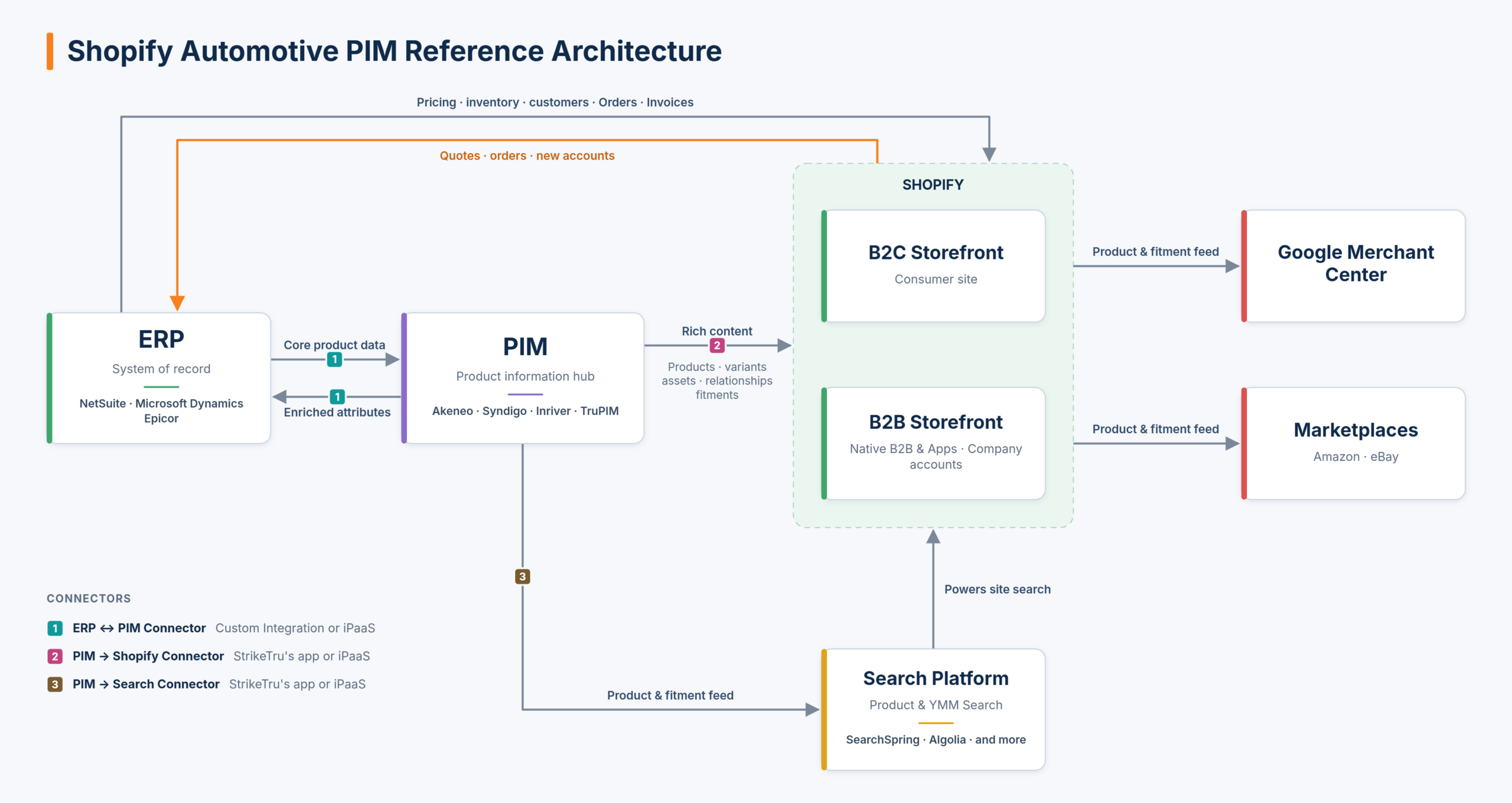
Automotive PIM for Shopify Merchants
An automotive PIM lets Shopify do what it does best, selling, while complex product and fitment data is managed and validated in one governed place. We sync collections, products, variants, kits, digital assets, metafields, metaobjects and Year/Make/Model data into Shopify, including fitment-based virtual SKUs and fitment notes, proven on an automotive retailer with 60K+ fitments per product.
Why Shopify Merchants Need an Automotive PIM
Shopify is excellent at commerce. Fitment-heavy catalogs push its product model hard.
Fitment at scale
Parts with thousands of applications and fitment notes don’t fit neatly into tags or a single metafield.
Variant and option platform limits
Fitment-specific variations can run into Shopify’s variant and option constraints.
Tag and metafield sprawl
Without governance, tags and metafields multiply and filters break.
Markets and localization
Selling in multiple markets multiplies content and pricing management.
Supplier data cleanup
Supplier spreadsheets need normalization before they reach Shopify.
Feed quality
Merchant Center performance depends on the same product data.
PIM vs Shopify: Who Owns What
Let each system do what it does best.
| Responsibility | PIM | Shopify |
|---|---|---|
| Product attributes, descriptions, taxonomy, relationships, bundles | Owns | Displays |
| Digital assets or URLs | Owns | Displays |
| Product bundles | Owns (Optional) | Displays |
| Fitment (YMM, qualifiers, notes) | Owns | Metafields/metaobjects, display & search |
| Collections structure | Owns or defines rules | Renders collections |
| Variants | Owns | Sells |
| Virtual SKUs | Generates by rule | Sells |
| Price & inventory | From ERP (optional) | Sells, Markets pricing |
| Orders, discounts, checkout | — | Owns |
Automotive PIM + Shopify: What We Build
Akeneo → Shopify connector
Products, variants, relationships, collections, brands, digital assets, metafields, and metaobjects synced from PIM.
Connector →YMM & fitment in metafields, metaobjects
YMM & fitment in metafields, metaobjects Fitment Data Management →
Fitment-based virtual SKUs
Dynamic virtual SKUs for fitment-specific listings without duplicating inventory.
Collections automation
Collections and category hierarchies assigned automatically from PIM data.
Shopify Markets
Localized content and market-specific data managed in the PIM.
Google Merchant Center feed
Virtual SKU feed data generated from governed product data.
From PIM to Shopify
Full integration patterns: Automotive PIM integrations →
What We See in Implementations
- Design the metafield model before importing. Retrofitting metafields across thousands of products is painful.
- Use virtual SKUs with clear rules back to physical products and inventory.
- Choose the YMM app last, after the fitment data model is settled.
Automotive Shopify & Other Case Studies
Automotive Parts Retailer
Category-based fitment assignment, YMM and metafields synced to Shopify with dynamic fitment-based virtual SKUs.
Read More →
Automotive Parts Distributor
NetSuite → Akeneo → BigCommerce with supplier-specific fitment, YMM synced to SearchSpring and near real-time sync.
Read More →
Motorsports Retailer | Pierce
PIM for a European motorsports retailer selling in multiple countries, with integrated translation.
Read More →Running an automotive catalog on Shopify?
We’ll review your product model, metafields, YMM setup and feeds, and show how a PIM would simplify them.
Do you have an Akeneo connector for Shopify?
Yes. StrikeTru offers an Akeneo PIM connector for Shopify, and our TruPIM also integrates with Shopify.
How do you store fitment in Shopify?
Fitment is governed in the PIM and published to Shopify metafields or metaobjects for display, filtering and YMM apps.
What are fitment-based virtual SKUs?
Listings generated for specific fitment variations without duplicating the physical product or splitting inventory. We used them for an automotive retailer with upto 60K+ fitments per product.
Can a PIM help with Shopify Markets?
Yes. Localized content and market-specific data can be managed in the PIM and synced to each market.
Will this improve Google Shopping performance?
Better product data improves feed quality and ROAS.
Review Your Shopify Automotive Data Architecture
Share your Shopify setup, catalog size and YMM approach. We’ll map the PIM-to-Shopify architecture that fits, with no pitch, just a working session.