For years, ecommerce teams optimized product catalogs for search engines, onsite search, and marketplace algorithms. The goal was straightforward: make products easy to find.
Today, AI is reshaping that journey.
Instead of browsing multiple websites, shoppers are asking ChatGPT questions like:
- What’s the best standing desk for a small home office?
- Recommend a brake pad for a 2021 Toyota Camry.
- Which air purifier is best for pet allergies?
Rather than returning a list of links, ChatGPT evaluates products, compares options, and recommends those that best satisfy the shopper’s intent.
This changes how products need to be prepared.
It’s no longer enough for products to be searchable. They need to be understandable, comparable, and trustworthy from an AI’s perspective.
So, what does it actually take to prepare your product catalog for ChatGPT Shopping?
The answer isn’t simply publishing another product feed. It requires building a catalog that provides AI with the structured information, context, and commerce signals needed to make confident recommendations.
Step 1: Build an AI-Ready Product Foundation
Every AI recommendation starts with product data.
Just as customers rely on product information to make purchasing decisions, AI relies on structured attributes to understand what a product is, compare it with alternatives, and determine whether it matches a customer’s request.
Every product should include consistent foundational attributes such as:
- Product Title
- Brand
- SKU
- GTIN/UPC/EAN
- Category
- Product Description
- Images
- Product URL
- Price and Currency
Beyond these fundamentals, every industry has attributes that define products more precisely.
For example:
- Automotive: Vehicle fitment, engine, position, compatibility
- Industrial: Material, dimensions, certifications
- Electronics: Connectivity, warranty, battery specifications
- Apparel: Size, fit, fabric, care instructions
These attributes allow AI to differentiate similar products and understand when one product is a better recommendation than another.
Implementation Checklist
Before preparing your catalog for AI-powered shopping, verify that every product has:
✓ Unique product identifiers
✓ Standardized attribute names and values
✓ Complete mandatory attributes
✓ High-quality images
✓ Consistent taxonomy
✓ Canonical product URLs
If attributes are incomplete or inconsistent, AI has less confidence in recommending your products.
Step 2: Ensure ChatGPT Can Access the Right Product Information
One common misconception is that merchants simply upload a product feed directly into ChatGPT.
In reality, AI shopping experiences rely on multiple sources of product information.
These may include:
- Product pages on your website
- Structured data (such as Schema.org markup)
- Merchant shopping feeds
- Public product documentation
- Pricing and availability information
- Product reviews
- Editorial and educational content
This makes consistency extremely important.
If specifications, pricing, availability, or product descriptions differ across systems, AI receives conflicting signals.
Preparing for AI commerce isn’t just about maintaining a clean PIM. It’s about ensuring your product information remains accurate and aligned wherever it appears.
Step 3: Enrich Products with Customer Knowledge
A specification sheet explains what a product is.
It rarely explains why someone should choose it.
Customers often ask questions such as:
- Will this fit my application?
- What’s included in the box?
- Is installation difficult?
- Which model should I choose?
- What’s the difference between these two products?
If those answers only exist in PDFs, customer support documents, or the knowledge of your sales team, AI has limited context.
Bringing that knowledge into your product experience helps AI generate more meaningful recommendations.
Consider enriching products with:
- FAQs
- Buying guides
- Installation instructions
- How-to articles
- Product comparison tables
- Videos
- Certifications
- Warranty information
- Recommended applications
- Compatibility guides
Equally important are the relationships between products.
Accessories, replacement parts, bundles, compatible products, and product variants help AI understand how products fit together throughout the buying journey—not just as individual items.
Step 4: Connect the Commerce Signals AI Uses
A product may perfectly match a customer’s needs, but AI also considers whether it’s a practical recommendation.
Commerce signals help answer that question.
| Commerce Signal | Why It Matters |
|---|---|
| Inventory | Avoid recommending unavailable products |
| Pricing | Compare value across similar products |
| Shipping | Recommend products that meet delivery expectations |
| Ratings & Reviews | Understand customer satisfaction |
| Understand customer satisfaction | Highlight signals such as Best Seller, Top Rated, Lowest Price, or Fast Shipping |
These signals often live across ecommerce platforms, ERP systems, inventory applications, review platforms, and fulfillment systems.
One implementation priority is ensuring these systems remain synchronized so AI receives accurate, current information rather than outdated snapshots.
Step 5: Structure Products the Way AI Thinks
Traditional search engines primarily index webpages.
AI understands relationships.
That’s an important distinction.
An AI-ready catalog should clearly model relationships such as:
- Parent and child products
- Variants
- Compatible products
- Replacement parts
- Accessories
- Bundles
- Alternative products
- Product hierarchies
- Standardized taxonomies
When these relationships are clearly defined, AI can answer much more sophisticated questions.
Instead of recommending a single product, it can suggest compatible accessories, identify replacement parts, compare variants, or recommend alternatives when inventory is unavailable.
This relational structure allows AI to support the entire buying journey—not just product discovery.
Step 6: Govern Product Data as an Ongoing Process
Preparing for ChatGPT Shopping isn’t a one-time project.
Product catalogs constantly evolve.
New products are introduced, specifications change, pricing is updated, inventory fluctuates, and categories expand.
Without governance, product quality gradually declines.
Organizations should continuously monitor:
- Attribute completeness
- Data consistency
- Duplicate products
- Standardized values
- Taxonomy quality
- Product freshness
Maintaining high-quality product data ensures AI continues receiving reliable information as your catalog evolves.
ChatGPT Shopping vs. Shopify: Different Roles, Same Customer Journey
As AI shopping gains momentum, many organizations wonder whether it replaces traditional ecommerce platforms.
It doesn’t.
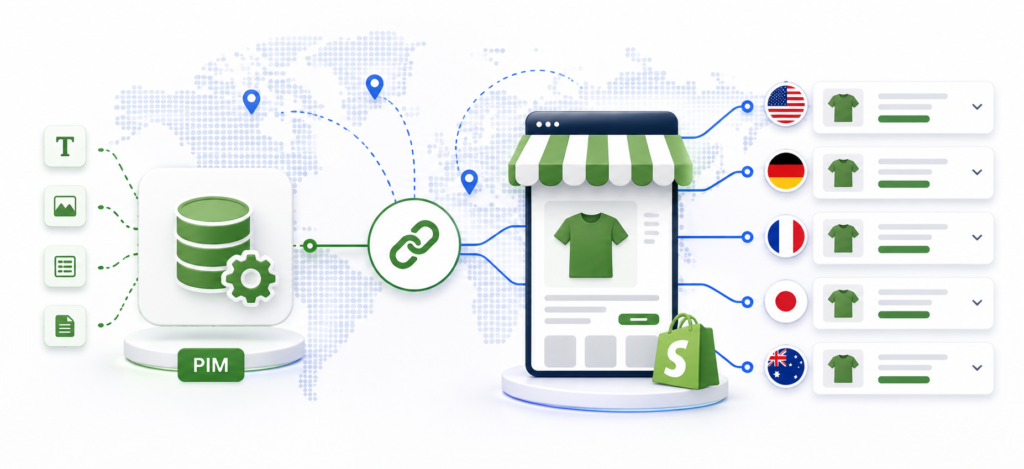
Platforms like Shopify are designed to manage commerce operations, including merchandising, shopping carts, checkout, payments, and order fulfillment.
ChatGPT serves a different role.
It helps customers research products, compare alternatives, and make informed purchasing decisions before directing them to a merchant’s ecommerce site.
Simply put:
- Shopify enables the transaction.
- ChatGPT influences the decision.
The two experiences complement each other, making product data consistency across both environments increasingly important.
Where Should You Start?
Preparing for AI-powered shopping doesn’t require rebuilding your ecommerce ecosystem overnight.
A practical implementation roadmap looks like this:
- Audit your existing product data for completeness and consistency.
- Standardize product attributes, taxonomy, and identifiers.
- Enrich products with educational and support content.
- Connect operational data such as inventory, pricing, and shipping.
- Continuously monitor and improve product data quality.
Most organizations don’t need another commerce platform.
They need stronger product data governance and a strategy for making their products understandable to AI.
Validate Your AI Readiness
Implementation doesn’t end once product information is published.
Organizations should regularly evaluate how AI interprets their catalogs by asking questions such as:
- Are our products appearing in AI-generated recommendations?
- Are key attributes being interpreted correctly?
- Is pricing and inventory current?
- Are competitors consistently being recommended instead of our products?
- Which product information is missing from AI-generated responses?
These insights help identify gaps that traditional ecommerce analytics often miss.
As AI shopping evolves, measuring AI discoverability should become part of every organization’s ongoing product data strategy.
AI Discoverability Is the Foundation of ChatGPT Shopping
ChatGPT Shopping is introducing a new way for customers to discover products, but success isn’t determined by AI alone.
It’s determined by the quality of the product information behind it.
Organizations that invest in structured product attributes, rich product content, connected commerce signals, semantic product relationships, and disciplined data governance will be better positioned for this shift.
At StrikeTru, we view this as more than preparing for a new shopping channel.
It’s about building product data that AI can understand, trust, and confidently recommend across the rapidly growing ecosystem of AI-powered commerce experiences.
As conversational commerce continues to mature, AI discoverability won’t be an added capability—it will become a fundamental requirement for digital commerce success.