What is Agentic Commerce?
Agentic Commerce is a new approach to online shopping where AI agents can discover, evaluate, recommend, and purchase products on behalf of customers.
Why Agentic Commerce Matters?
Traditional eCommerce requires customers to:
- Search for products
- Compare options
- Check pricing and availability
- Read reviews
- Complete checkout
Agentic Commerce reduces this effort by allowing AI to handle most of these tasks automatically.
For merchants selling online, this creates faster buying journeys, more personalized experiences, and new opportunities to increase conversions.
Traditional Commerce vs Agentic Commerce
| Traditional Commerce | Agentic Commerce |
|---|---|
| Product-focused search | Intent-focused discovery |
| Customers perform research | AI performs research |
| Manual comparison | Automated evaluation |
| Human-driven decisions | AI-assisted decisions |
| Website is the primary interface | AI becomes the primary interface |
The shift is simple: customers describe what they need, and AI finds the best solution.
AI is Becoming a Buying Interface: Half of consumers now intentionally use AI-powered search, and many consider it their primary digital source for purchase decisions. – Mckinsey
How Agentic Commerce Works ?
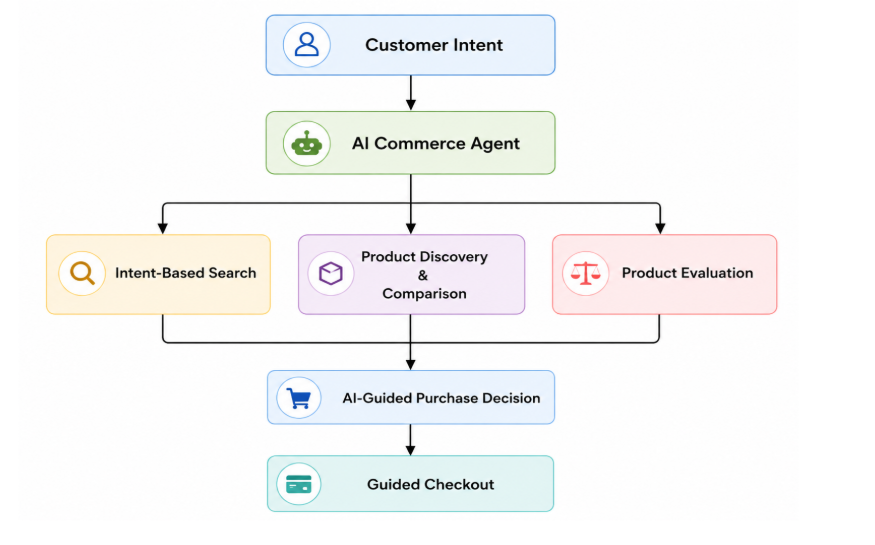
Imagine a customer asking ChatGPT or Claude:
“What’s the best brake pad set for a 2021 Toyota Camry that’s quiet, durable, and under $100?”
Instead of manually searching multiple websites, the AI agent handles much of the shopping journey.
- Understands Customer Intent
Interprets the customer’s needs, preferences, budget, and buying requirements. - Discovers Relevant Products
Searches merchant catalogs and marketplaces to find suitable products. - Evaluates & Compares Options
Analyzes specifications, pricing, reviews, availability, and trade-offs. - Recommends the Best Fit
Suggests the most relevant product based on the customer’s priorities. - Facilitates Purchase
Guides the customer to checkout or completes parts of the buying process.
In Agentic Commerce, AI becomes an active participant in the buying journey, not just a search tool.
Different Types of Agentic Commerce Interaction Models
Interaction models define how AI agents communicate and interact with consumers, merchants, and platforms to discover products, make decisions, and complete transactions in an Agentic Commerce ecosystem.
- Agent-to-Site
AI agents interact directly with merchant websites to discover products and complete purchases.
Example: ChatGPT finds products directly from your online store.
Agent-to-Agent
A buyer’s AI agent communicates directly with a merchant’s AI agent.
Example: AI agents exchange pricing, inventory, and fulfillment information automatically.
Brokered Agent-to-Site
An AI platform acts as the intermediary between customers and merchants.
Example: ChatGPT compares products across multiple stores and recommends the best option.
The Tech Behind Agentic Commerce
Several emerging standards are helping AI agents interact with commerce systems.
MCP (Model Context Protocol), released by Anthropic in November 2024
Allows AI agents to access business data such as:
- Product catalogs
- Inventory
- Pricing
- Customer information
ACP (Agentic Commerce Protocol), co-developed by OpenAI and Stripe
Enables AI agents to perform commerce transactions such as:
- Purchasing
- Checkout
- Payments
- Order fulfillment
UCP (Universal Commerce Protocol), announced by Google in January 2026
Provides a standardized framework for the entire shopping journey, helping AI agents and merchants work together more seamlessly.
Retailers Are Already Investing: 70% of retailers have already piloted or partially implemented AI agents, while 88% view AI as strategically important to their business.
How do eCommerce Platforms Enable Agentic Commercee
Agentic Commerce is not tied to a single platform. Commerce platforms like Shopify, Salesforce, BigCommerce, etc., are introducing capabilities that help AI agents discover products, answer customer questions, and facilitate purchases.
Let’s use Shopify as an example. Shopify has recently introduced Agentic Storefronts and AI shopping channel capabilities that provide one of the clearest examples of how Agentic Commerce is being implemented today.
- Merchant Shares Product & Business Data
The merchant makes product information, pricing, availability, policies, and business information accessible through the commerce platform. - AI Platforms Discover Products
Participating AI platforms can access and understand merchant catalogs, making products eligible to appear in AI-powered shopping experiences. - Customers Shop Through AI
Instead of searching multiple websites, customers ask questions such as:
“I need a replacement key fob for a 2020 Honda Accord that supports remote start.”
The AI evaluates available products and presents the most relevant options. - AI Assists the Buying Decision
The AI helps customers compare products, answer questions, and identify the best fit based on their requirements. - Commerce Platform Handles the Transaction
Once a customer decides to purchase, the commerce platform manages checkout, payments, taxes, order management, and fulfillment through its existing commerce infrastructure.
The Missing Piece: Product Intelligence
AI agents don’t just need product names, descriptions, and prices.
They need rich product knowledge.
When a customer asks:
“Will this part fit my vehicle?”
“What’s included in the box?”
“What warranty is included?”
“Can you show me installation instructions?”
The AI can only answer using the information available to it.
This is why Product Information Management (PIM) systems become so important in Agentic Commerce.
A PIM helps merchants manage and enrich at SCALE:
- Product attributes and specifications
- Compatibility and fitment data
- Product-specific FAQs
- Warranty information
- Shipping details
- Installation guides
- How-to videos
- Certifications and compliance data
- Digital assets and supporting content
At scale, this creates a richer knowledge layer that helps AI agents better understand, compare, recommend, and sell products.
Commerce platforms enable Agentic Commerce. PIM provides the product intelligence that makes it effective.
For additional details, see Shopify’s Agentic Storefronts documentation.
AI Search is Reshaping Discovery: About 50% of Google searches already include AI-generated summaries, and that figure is expected to exceed 75% by 2028. – Mckinsey
Conclusion
Agentic Commerce is here, and AI is becoming a new shopping channel.
While commerce platforms are enabling AI-powered shopping, the real differentiator will be product data. Merchants with rich, accurate, and AI-ready product information will be more likely to be discovered, recommended, and purchased by AI agents. As AI-powered search and shopping experiences evolve, AI discoverability will become just as important as traditional SEO.
This is where Product Information Management (PIM), product enrichment, and data governance become increasingly important. At StrikeTru, we help businesses create AI-ready product experiences by improving product data quality, scalability, and discoverability across commerce channels.