
How Raney’s Scaled B2B Commerce with BigCommerce B2B Edition & Multi-Storefront

Home Resources How Raney’s Launched a Scalable B2B Store with BigCommerce Multi-Storefront and ERP Integration How Raney’s Scaled B2B Commerce with BigCommerce B2B Edition & Multi-Storefront Built a modern B2B commerce platform integrated with NetSuite ERP and Pimberly PIM to streamline quoting, ordering, and invoicing at scale. Raney’s at a Glance Leading provider of aftermarket parts for the Heavy Duty Trucking industry Large multi-customer B2B operation High SKU volume and complex pricing requirements Focused on modernizing digital buying for dealers and enterprise customers Tech Stack Platforms BigCommerce BigCommerce B2B Edition NetSuite ERP Pimberly PIM Integrations Pimberly PIM ? BigCommerce NetSuite ERP ? BigCommerce 1. The Problem Raney’s needed to modernize its B2B commerce operations to better serve dealers and enterprise customers. With 100,000 SKUs, hundreds of B2B customers, and thousands of customer locations, the existing processes for quoting, ordering, and invoicing were operationally heavy and difficult to scale. Customers expected: Faster product discovery Personalized pricing and credit terms Streamlined digital quoting and reordering B2C-style buying experiences in a B2B environment Internally, sales and support teams required better visibility and synchronized data across systems. Raney’s needed a scalable B2B commerce foundation integrated tightly with ERP and PIM. 2. What Was Holding Them Back Manual or fragmented quoting and ordering workflows Complex customer-specific pricing structures Difficulty scaling operations across 800+ customers and 2,000 locations Lack of a unified B2B digital buying experience Without modernization, growth would increase operational complexity instead of efficiency. 3. What They Needed Raney’s required: A modern B2B storefront built on a scalable commerce platform Login-based B2B buying experiences 4-tier customer pricing architecture Company accounts with credit limits and payment terms Seamless ERP synchronization for quotes, orders, and invoices Multi-storefront architecture to support brand and operational flexibility A phased rollout strategy to minimize risk The goal was to streamline digital commerce while improving customer and employee efficiency. 4. How We Solved It StrikeTru led an end-to-end B2B commerce implementation tailored to Raney’s operational scale. Implemented BigCommerce Multi-Storefront & B2B Edition Designed and launched a login-based B2B storefront Configured company accounts and buyer portal features Enabled personalized price lists, payment methods, credit limits, and terms Implemented assisted ordering and sales rep masquerading Customized storefront theme for B2B branding and UX The new platform delivered a B2C-like buying experience tailored for B2B operations. Architected Tiered Pricing at Scale Configured 4-tier price lists across 100,000 SKUs Automated pricing logic aligned with ERP data Supported 800 B2B customers and 2,000 locations Ensured accurate, customer-specific pricing visibility Pricing became scalable, automated, and reliable. Executed Phased Rollout & Enablement Initial rollout to 100 customers Data cleansing and migration of company records End-to-end testing and user acceptance validation User training for internal teams Go-live support and hypercare The phased approach minimized disruption and ensured adoption. 5. The Impact Before StrikeTru Operationally heavy quoting and ordering processes Complex pricing structures managed with effort Fragmented ERP and storefront workflows Limited B2B digital buying experience After StrikeTru Modern B2B storefront powered by BigCommerce 100,000 SKUs available with structured pricing tiers 800+ B2B customers supported Automated ERP integration for quotes, orders, and invoices Personalized pricing, credit terms, and buyer portal features Streamlined digital workflows for customers and sales teams Raney’s now operates on a scalable B2B commerce infrastructure designed to support growth across customers, locations, and product volume. Launching a B2B Commerce Platform? We design scalable B2B ecosystems powered by PIM, ERP integration, and automation. Schedule a Strategy Call B2B Commerce Read More Success Stories
How Brickworks Modernized Multi-Site Commerce with PIM and DAM

Home Resources How Brickworks Modernized Multi-Site Commerce with PIM and DAM How Brickworks Modernized Multi-Site Commerce with PIM and DAM Turned around a stalled data & commerce program, launched 9 branded websites in 5 months Brickworks At A Glance Global building materials manufacturer Operating in Australia, New Zealand, and USA $1B+ in annual revenue 9 brands, 1000+ products, 3000+ SKUs, 5000+ assets Tech Stack Platforms Akeneo PIM Adobe Commerce Acquia DAM Integrations Acquia DAM ? Akeneo PIM Akeneo PIM ? Adobe Commerce 1. The Problem Brickworks, a global building materials manufacturer with over $1B in annual revenue, needed to modernize how product data and digital assets powered its digital channels. An earlier attempt to implement PIM, DAM, and eCommerce had become bloated and fragile. Product updates were slow, duplication was widespread, and scaling across multiple branded websites introduced risk instead of speed. The program had stalled. The business needed momentum restored quickly. 2. What Was Holding Them Back The challenges were structural: Fragmented product data and digital assets No reliable single source of truth across brands and regions High duplication increasing cost and operational effort Data models not designed for multi-site scale Limited visibility into what data was changing and when The existing setup could not support faster updates, stronger governance, or future automation. 3. What They Needed To move forward, the business needed: A governed single source of truth for product data and assets Faster launches and updates across 9 branded websites Rich, site-specific product content and digital assets Simplified data management with minimal duplication Real-time visibility into ongoing data changes A scalable foundation with reduced IT dependency 4. How We Solved It StrikeTru reset the program with a focus on clarity, scalability, and operational readiness. We implemented Akeneo PIM and Acquia DAM as the central product data and asset backbone, purpose-built for a multi-brand, multi-site commerce environment. Key elements of the solution included: Scalable data models supporting brands, regions, and channels without redundancy Centralized enrichment workflows for products, specifications, pricing, and digital assets Seamless integration between PIM, DAM, and Adobe Commerce An event-driven reporting framework within Akeneo, delivering custom daily change reports to relevant teams AI-driven image alt text enrichment, automating accessibility and SEO-ready content updates at scale The turnaround was delivered in five months, replacing a stalled initiative with a stable, business-owned system. 5. The Impact Before StrikeTru Fragmented product data and digital assets Slow, manual updates across websites Limited visibility into data changes High duplication and heavy IT dependency After StrikeTru A single source of truth for product data and assets Faster, consistent launches across 9 branded websites Real-time visibility into daily product and content changes Automated enrichment improving content quality at scale Reduced complexity, duplication, and operational overhead The foundation is now built to scale, not just to launch. Scaling Multi-Site Commerce Across Brands? We centralize PIM and DAM to power governed, automation-ready digital ecosystems. Schedule a Strategy Call PIM Implementation Read More Success Stories
How an Automotive Keys Distributor Scaled Commerce with Akeneo

Home Resources How an Automotive Distributor Scaled Commerce with Akeneo How an Automotive Distributor Scaled Commerce with Akeneo Replaced ERP-centric catalog operations with a governed PIM architecture and enabled near real-time BigCommerce synchronization across 50,000+ SKUs. The Organization At A Glance Leading U.S. distributor of automotive keys and remotes Serving locksmiths, resellers, and automotive professionals 100+ brands, 50,000+ SKUs Complex vehicle fitment-driven catalog Tech Stack Platforms Akeneo PIM BigCommerce NetSuite ERP SearchSpring Integrations NetSuite ? Akeneo PIM Akeneo PIM ? BigCommerce Akeneo PIM ? SearchSpring PIM ? Microsoft Teams 1. The Problem The organization operates one of the most complex automotive aftermarket catalogs in its segment. With over 50,000 SKUs, dense variant structures, and detailed vehicle fitment logic, product data precision is mission-critical. However, product information was managed primarily within ERP workflows — not a system designed for enrichment, governance, or multi-channel commerce agility. As digital expectations increased, limitations became clear: Manual update cycles High IT dependency Limited enrichment governance Inconsistent visibility into storefront synchronization No centralized control over completeness and validation AKG did not need another integration layer. They needed a scalable product data architecture built for commerce. 2. What Was Holding Them Back The challenges were systemic: ERP-centric product modeling limiting enrichment scalability Unstructured fitment logic requiring manual validation Attribute inconsistencies reducing automation potential Manual SEO construction and storefront formatting Limited transparency into sync status and job monitoring No governed, centralized source of truth The catalog functioned operationally — but it was not engineered for automation, governance, or long-term scale. 3. What They Needed To modernize confidently, organization required: A governed single source of truth for product information Structured family and variant modeling within Akeneo Automated handling of vehicle fitment data Controlled, near real-time BigCommerce synchronization Seamless alignment with NetSuite and SearchSpring Business-user enablement without increased IT overhead A scalable architecture supporting long-term multi-channel growth This was positioned as a commerce infrastructure initiative — not just a PIM implementation. 4. How We Solved It StrikeTru engineered a scalable, automation-driven ecosystem centered on Akeneo PIM Enterprise, purpose-built for high-variant automotive catalogs. Established an Enterprise PIM Foundation Migrated 50,000+ SKUs, variants, brands, categories, assets, and fitments Designed scalable families and family variants aligned to automotive product types Converted flat attributes into structured, validated data types Implemented enrichment workflows and approval governance Configured role-based permissions for operational clarity Product data shifted from ERP-managed records to governed, commerce-ready assets. Engineered Intelligent Fitment & Attribute Automation To reduce manual effort and increase precision, we implemented custom automation frameworks: Fitment Automation Automated generation of year–make–model compatibility data Continuous reconciliation of FITS values Standardized storefront presentation logic Brand & Category Governance Automated validation against governed brand reference entities Scheduled reconciliation of brand-category mappings Preservation of non-brand taxonomy structures Calculated & Concatenated Attributes Configurable generation of SEO-ready keyword fields Automated identifier concatenation for search optimization Structured logging for traceability and monitoring These automations increased enrichment velocity while maintaining governance controls. Configured Governance & Business Rules Leveraging Akeneo’s native rule engine, we implemented: Automated variant pricing logic Standardized shipping group assignments Inventory and DropShip rule controls Purchasability and search visibility automation Controlled category state management Commerce logic became predictable, governed, and scalable. Enabled Real-Time Commerce Integration Using StrikeTru’s BigCommerce Connector: Near real-time synchronization of products, variants, categories, brands, and fitments Support for metafields and custom transformations Granular sync rules based on approval and completeness thresholds On-demand and scheduled job control Automated reporting to Microsoft Teams This eliminated custom middleware while providing operational transparency. Aligned ERP & Search Systems Preserved NetSuite as the financial and inventory authority Reduced duplication across enterprise systems Delivered structured data to SearchSpring for improved filtering and discovery 5. The Impact Before StrikeTru ERP-driven product management Manual enrichment cycles High IT dependency Limited storefront sync transparency Operational duplication After StrikeTru Governed single source of truth in Akeneo PIM 50,000+ SKUs centrally enriched and validated Automated vehicle fitment processing Near real-time BigCommerce synchronization Business-user self-service with controlled workflows Microsoft Teams-based sync monitoring Reduced integration complexity Architecture built for scalable commerce growth The organization now operates on a product data foundation engineered for governance, automation, and enterprise scalability. Modernizing Automotive Product Data? We engineer scalable PIM foundations that automate fitment, enrichment, and commerce. Schedule a Strategy Call PIM Implementation Read More Success Stories
How an Automotive Parts Manufacturer Centralized Product Data with Akeneo

Home Resources How an Automotive Aftermarket Manufacturer Centralized Product Data with Akeneo How an Auto Parts Manufacturer Laid the Foundation for Data-Driven Automotive Commerce Replaced fragmented ERP and legacy PIM workflows with a governed single source of truth and enabled automation-driven commerce syndication. The Organization At A Glance Leading U.S. supplier of truck and classic car aftermarket parts Serving distributors, retailers, and DTC channels Thousands of SKUs across Truck and Classic segments Multi-channel presence including Shopify, Miva Commerce, Amazon, and more Tech Stack Platforms Akeneo PIM Microsoft Dynamics NAV ERP Miva Commerce Integrations NAV ? Akeneo PIM Akeneo ? Miva Commece 1. The Problem The organization operated a distributed product ecosystem across ERP, legacy PIM tools, storefront platforms, and manual workflows. Product data was split between NAV for ERP management, Perfion for catalog generation, multiple storefront platforms, manual Shopify and Amazon updates, and locally managed assets. Fitment and translation files were handled separately. As channel complexity increased, the architecture became operationally heavy: Duplicate product maintenance across systems Manual enrichment and marketplace updates Inconsistent fitment management Limited governance visibility Commerce tightly coupled to ERP workflows The business needed more than incremental improvements. It needed a centralized, scalable product data architecture. 2. What Was Holding Them Back Fragmented system ownership of product data Dual PIM maintenance across Perfion and commerce platforms Unstructured YMM fitment handling Scattered digital asset governance Limited automation and monitoring The catalog worked — but it was not engineered for scale, automation, or long-term agility. 3. What They Needed The organization required: A governed single source of truth for enrichment Centralized asset and fitment management Automated brand-based categorization Structured YMM standardization Commerce decoupled from ERP dependencies API-driven multi-channel syndication Scalable infrastructure to support growth This initiative was positioned as a phased modernization of their entire product ecosystem. 4. How We Solved It StrikeTru architected a two-phase transformation centered on Akeneo as the operational backbone. Centralized the Product Foundation Key elements of the solution included: Migrated data from NAV and Perfion into Akeneo Structured families, variants, attributes, and categories Centralized digital assets into governed asset families Brought fitment management directly into PIM Established Akeneo as the enrichment and distribution layer This eliminated duplication and introduced governance without disrupting operations. Modernized Commerce Architecture Retired legacy Sana storefront infrastructure Implemented Miva as the primary commerce engine Positioned Akeneo as the authoritative commerce data source Preserved Perfion exclusively for catalog generation Final architecture: NAV ? Akeneo ? Miva Commerce became decoupled, API-driven, and scalable. Engineered Intelligent Automation To increase enrichment velocity and reduce manual effort, we implemented automation frameworks: Brand Categorization Automation Programmatic brand category assignments Reconciliation of incorrect mappings Preservation of taxonomy structures Search & Attribute Optimization Automated concatenation of identifiers and part numbers Generation of SEO-ready keyword attributes Delta-based updates for efficiency Structured Fitment Management Standardized YMM compatibility mapping Reduced manual compatibility errors Improved storefront presentation consistency Automation strengthened governance while accelerating enrichment. Strengthened Governance & Business Rules Configured 300+ catalog behavior rules Automated variant pricing and shipping logic Controlled purchasability and search visibility flags Standardized inventory tracking logic Enabled predictable, repeatable catalog operations Catalog management shifted from reactive correction to structured control. 5. The Impact Before StrikeTru Fragmented product data ownership Dual PIM maintenance Scattered asset governance ERP-dependent commerce architecture Limited automation visibility After StrikeTru Governed single source of truth in Akeneo Centralized enrichment across all channels Commerce decoupled from ERP Automated brand and fitment logic API-driven multi-channel syndication Scalable digital asset governance Reduced duplication and operational friction The organization now operates on a modern product data architecture engineered for scale, automation, and long-term commerce agility. Ready to Scale Multi-Channel Commerce? We design governed product data foundations that power enrichment, automation, and seamless syndication. Schedule a Strategy Call PIM Implementation Recent Success Stories
How City Furniture Modernized Omnichannel Commerce with PIM & DAM

Home Resources How City Furniture Modernized Omnichannel Commerce with PIM & DAM How City Furniture Modernized Omnichannel Commerce with PIM & DAM Implemented Akeneo PIM and Widen DAM to centralize product data, automate enrichment, and accelerate digital growth across 32 stores and multiple channels. City Furniture at a Glance Top U.S. furniture retailer 50+ years in business 32 retail stores across Florida 100K+ SKUs across furniture and home accents Omnichannel operations (store, web, mobile, marketplaces) Tech Stack Platforms Akeneo Enterprise PIM Widen DAM AS400 ERP Productsup Integrations AS400 ERP ? Akeneo PIM Akeneo PIM ? Widen DAM Akeneo PIM ? Magento Akeneo PIM ? Productsup 1. The Problem City Furniture’s growth ambitions were constrained by fragmented systems and manual processes. Product data lived across AS400 ERP, Adobe Scene 7 DAM, spreadsheets, custom databases, and sync scripts. Digital assets were difficult to manage and manually linked to SKUs. Product errors, pricing discrepancies, and missing imagery impacted searchability and customer experience. Launching new SKUs could take weeks. Bulk updates were difficult. Omnichannel synchronization was unreliable. As competition intensified and customer expectations evolved, City needed a centralized, scalable product data and digital asset foundation. 2. What Was Holding Them Back No centralized system governing product data and assets Manual SKU setup and content updates Inconsistent pricing and availability across channels Legacy DAM limited to web imagery Limited automation for syndicating enriched content to marketplaces High operational overhead managing disconnected systems Without modernization, scaling product assortments and digital channels would increase complexity and cost. 3. What They Needed City Furniture required: A centralized PIM as the core data hub A modern DAM for scalable asset governance Bi-directional automation between PIM and DAM Faster SKU setup and bulk editing capabilities Reliable omnichannel syndication Reduced reliance on legacy custom tools Improved visibility, reporting, and governance The objective was to modernize operations while accelerating digital growth. 4. How We Solved It StrikeTru executed a two-stage transformation that centralized data, automated asset management, and streamlined omnichannel operations. Established Akeneo as the Product Data Core Implemented Akeneo Enterprise PIM Designed product and digital asset taxonomies Defined validation rules, enrichment workflows, and approval processes Migrated 100K+ SKUs and structured 75K+ product models Bulk edit capabilities, product completeness, and real-time reporting SKU setup time dropped by 50% Deployed Widen DAM with Bi-Directional Integration Replaced Adobe Scene 7 with Widen DAM Migrated 25,000+ digital assets including images, 3D renders, swatches, PDFs, and brand materials Implemented bi-directional PIM ? DAM integration via StrikeTru connector Automated asset linking and enrichment across systems Digital asset management became automated instead of manual. Automated Omnichannel Syndication Integrated PIM with Magento and mobile POS systems Configured feed automation via Productsup Increased web sync frequency by 150% Ensured consistent pricing, attributes, and availability across channels This eliminated frequent discrepancies between store and online channels. Retired Legacy Systems & Reduced Complexity Decommissioned 4 legacy tools and custom processes Simplified system architecture Reduced operational overhead Improved data governance and enterprise visibility City avoided costly ERP overhauls by shifting product mastering to PIM. 5. The Impact Before StrikeTru Fragmented systems and manual asset linking Weeks to launch new SKUs Pricing discrepancies and content errors Limited bulk editing and reporting High operational complexity After StrikeTru Centralized PIM & DAM foundation 100K+ SKUs governed and structured Automated bi-directional asset management 50% faster SKU setup 150% increase in sync frequency 4 legacy systems retired Improved searchability and omnichannel consistency City Furniture now operates on a modern PIM-driven architecture that supports rapid merchandising, scalable enrichment, and unified omnichannel experiences. Scaling Omnichannel Retail with PIM and DAM? We unify PIM and DAM to streamline enrichment, syndication, and omnichannel growth. Schedule a Strategy Call Read More Success Stories
How an Industrial Equipment Manufacturer Replatformed to Akeneo and Scaled B2B Commerce

Home Resources How Ballymore Replatformed to Akeneo and Scaled B2B Commerce How an Industrial Equipment Manufacturer Replatformed to Akeneo and Scaled B2B Commerce Replaced a sunset PIM with Akeneo, preserved eCommerce continuity, and restructured a complex B2B catalog for scalable BigCommerce operations. The Organization At A Glance U.S. based manufacturer industrial equipment Founded in 1945 Multi-brand portfolio Complex configurable lift and ladder products Thousands of SKUs and high variant complexity Tech Stack Platforms Akeneo PIM BigCommerce Amber Engine (legacy) Integrations Akeneo PIM ? BigCommerce 1. The Problem The manufacturer needed to urgently replace its legacy PIM before it was sunset, without disrupting ongoing eCommerce operations. The business relied heavily on BigCommerce to serve its B2B customers. Any disruption to product data, assets, or storefront synchronization would directly impact online revenue and operations. At the same time, the catalog architecture needed to evolve to support future scale. Product structures were complex, variant combinations were extensive, and the data foundation needed to support governance, automation, and long-term growth. This was not just a migration. It was a critical transformation with zero margin for downtime. 2. What Was Holding Them Back Phase 1: Urgency and Execution Risk A firm 6-week deadline before the legacy PIM sunset Deeply embedded product and asset structures in the existing system Complex integration requirements with BigCommerce Limited tolerance for operational disruption Ballymore needed a partner who could confidently interpret the existing data model, execute the migration precisely, and ensure storefront continuity from day one. Phase 2: Structural Scale Challenges Once stabilized on Akeneo, deeper structural challenges surfaced: No formalized variant modeling for configurable lift products 10,000+ possible configuration combinations across certain product lines BigCommerce’s 600-variant cap limiting how complex products could be represented 3. What They Needed The manufacturer required: A rapid, low-risk migration to Akeneo PIM Business continuity across BigCommerce during transition A structured product model using families and family variants Intelligent handling of complex variant combinations Accurate synchronization of products, variants, options, custom fields, and metafields A future-ready B2B product data architecture 4. How We Solved It StrikeTru executed the transformation in two tightly aligned phases. Phase 1: Rapid Replatforming with Continuity Performed a structured lift-and-shift migration from Amber Engine to Akeneo Migrated all product data and digital assets successfully Converted exported data into Akeneo-compatible formats Integrated Akeneo with BigCommerce to maintain uninterrupted product sync Delivered full operational continuity within six weeks This phase established a stable foundation while protecting revenue and operations. Phase 2: Catalog Engineering for Scale With the platform stabilized, we restructured the catalog for scalability and governance. Advanced Product Modeling Converted flat SKUs into structured product models and variants Designed families, family variants and variant axes aligned to real product logic Introduced structured attribute types to enable validation and automation Variant Constraint Engineering Strategically split and grouped products to stay within BigCommerce’s 600-variant limit Modeled 10,000+ configuration combinations without degrading storefront experience Preserved logical product hierarchies while respecting platform constraints Automation and Optimization Implemented calculated and concatenated attributes Reduced manual data entry through controlled automation Ensured consistent representation across channels Connector-Driven Synchronization Synced enriched products, variants, custom options, images, and metafields via StrikeTru’s BigCommerce connector Ensured complete accuracy between Akeneo and BigCommerce This approach transformed the catalog from operational to strategic. 5. The Impact Before StrikeTru Legacy PIM approaching sunset High execution risk during migration Complex variant combinations constrained by platform limits Limited structural modeling for scalable growth After StrikeTru Migrated to Akeneo PIM in 6 weeks Zero disruption to BigCommerce operations Structured product models and family variants implemented 10K+ variant combinations engineered within platform constraints Seamless synchronization across systems Scalable, governance-ready B2B catalog foundation The manufacturer now operates on a modern PIM architecture designed for scale, flexibility, and long-term digital growth. Modernizing a Complex B2B Catalog? We design governed PIM architectures built for scale and seamless integrations. Schedule a Strategy Call Read More Success Stories
How Richmond Supply Built & Scaled a PIM-Driven B2B Commerce

Home Resources How Richmond Supply Built a PIM-Driven Commerce Foundation and Scaled B2B on BigCommerce How Richmond Supply Built & Scaled a PIM-Driven B2B Commerce Established Akeneo as the single source of truth, restructured 30K+ SKUs, automated ERP-driven pricing, and launched a modern B2B & B2C experience. Richmond Supply at a Glance 85-year-old regional industrial supply company Headquartered in Augusta, Georgia Serves both B2B and B2C customers Large and expanding industrial product catalog Long-standing StrikeTru partner Tech Stack Platforms Akeneo PIM BigCommerce (B2B Edition) Magnatron ERP Magento (legacy platform) Integrations Akeneo PIM ? BigCommerce ERP ? Akeneo PIM Magnatron ERP ? BigCommerce 1. The Problem Richmond Supply’s digital growth was constrained by catalog complexity and operational friction. Product data was managed largely at the flat SKU level, limiting structured merchandising, discoverability, and governance. Search and navigation required improvement. Daily price and availability updates depended on coordination across systems. Customer-specific B2B pricing across thousands of SKUs lacked scalable automation. At the same time, the legacy commerce (Magento) environment required ongoing maintenance, limiting agility and slowing digital initiatives. Richmond Supply needed more than a platform upgrade. They needed a modern, PIM-driven data foundation built for scalable commerce. 2. What Was Holding Them Back Flat SKU structures limiting product/variant relationships Manual effort in onboarding and enriching new product lines Inconsistent taxonomy and product data standards Limited automation between ERP, product data, and storefront Storefront with B2B capabilities for wholesale customers Customer-specific pricing managed with operational overhead Without structural change, expanding the catalog would increase complexity instead of growth. 3. What They Needed Richmond Supply required: A centralized PIM to govern product data Structured product models instead of flat SKUs Faster onboarding of new product lines AI-assisted enrichment to scale data operations Seamless ERP-driven price and availability automation A modern BigCommerce B2B storefront with advanced buyer features Tier-based B2B pricing across thousands of SKUs The goal was to create a scalable infrastructure that supported both operational efficiency and revenue growth. 4. How We Solved It StrikeTru led a comprehensive transformation across product data, commerce, integrations, and B2B enablement. Established Akeneo as the Data Backbone Deployed Akeneo PIM as the single source of truth Restructured 30,000+ flat SKUs into organized product models and variants Standardized taxonomy, attributes, LOVs, UOMs, etc. Cleaned and rationalized the catalog Enabled internal teams to manage enrichment and governance in-house Akeneo became the operational foundation for scalable data management. Modernized Commerce with BigCommerce B2B Edition Launched a new BigCommerce storefront Implemented B2B Edition with company accounts and buyer workflows Enabled shopping lists, quick reordering, and improved search Reduced platform maintenance overhead Improved UX and merchandising flexibility Commerce became easier to manage and faster to evolve. Automated Tier-Based B2B Pricing Built integration from Magnatron ERP into BigCommerce Automatically generated 50+ customer-specific price lists Created a default B2B price list for standardized pricing Ensured thousands of SKUs reflected accurate daily pricing Eliminated manual pricing maintenance This delivered pricing accuracy at scale while reducing operational effort. Accelerated Product Acquisition with AI & Data Stewardship Sourced product data from Affiliate Distributors and other industrial databases Used AI to accelerate data enrichment Applied structured formulas and validation rules Combined automation with human data stewardship oversight This reduced onboarding time for new product lines and allowed Richmond Supply to expand its assortment faster. 5. The Impact Before StrikeTru Flat SKU catalog limiting discovery Manual pricing management Slow onboarding of new products Limited automation between ERP and storefront High maintenance complexity After StrikeTru Akeneo PIM as centralized data foundation 30K+ SKUs structured and enriched AI-assisted onboarding accelerating product expansion Automated ERP-driven price and availability sync Tier-based pricing for 50+ B2B customers Improved SEO, searchability, and discoverability Scalable BigCommerce B2B storefront Richmond Supply now operates on a modern commerce and product data infrastructure designed to support sustained B2B and B2C growth. Modernize Your PIM, DAM, Commerce, and AI Strategy Design a scalable data foundation that powers automation, enrichment, and growth. Schedule a Strategy Call PIM Implementation Read More Success Stories
How Boss Supply Modernized BigCommerce from V2 to V3 and Enabled Scalable Commerce

Home Resources How Boss Supply Modernized BigCommerce from V2 to V3 and Enabled Scalable Commerce How Boss Supply Modernized BigCommerce from V2 to V3 and Enabled Scalable Commerce Executed a complex V2 to V3 migration with automation, preserving product logic and enabling a modern, scalable commerce foundation. Boss Supply at a Glance Beauty and personal care retailer with growing eCommerce operations 1,600+ products and 2,700+ SKUs Complex product configurations and option logic Heavy use of rules, modifiers, and product relationships Business dependent on uninterrupted storefront operations Tech Stack Platforms BigCommerce V2 (Legacy) BigCommerce V3 (Modern Experience) Integrations Products and SKUs Product options and option sets Product rules and option set rules Configurable fields and Custom fields Other standard product data 1. The Problem Boss Supply was operating on BigCommerce V2, a legacy architecture that could not support the next phase of growth. While functional, the system was limiting: Product experience flexibility Use of modern BigCommerce APIs and features Ability to scale across storefronts and channels At the same time, their catalog had grown increasingly complex: Over 2,700 SKUs 1,100+ product and option rules Deep dependencies between options, SKUs, and pricing logic Migrating this catalog was not straightforward. It required transforming how product data was structured — without disrupting business operations. 2. What Was Holding Them Back Did not have an experienced partner to perform this migration V2 option structures not directly compatible with V3 Option set rules migration was complex Products with mixed option types and SKU dependencies SKU generation logic that was not consistently followed Platform constraints like the 600-variant limit in V3 Risk of data loss, broken logic, or inconsistent storefront behavior Without a structured approach, migration could result in: Partial product failures Manual rebuild efforts Store downtime and lost revenue 3. What They Needed Boss Supply required: A reliable partner, and a white-glove highly automated migration from V2 to V3 Handing complex product structures without data loss Preservation of pricing rules, SKU logic, and product relationships Identification and handling of exception scenarios upfront Minimal downtime during transition A future-ready catalog aligned with BigCommerce V3 capabilities The goal was to modernize without compromise. 4. How We Solved It StrikeTru executed a structured, app-enabled migration approach designed for complex catalogs. Automated Catalog Transformation Migrated products, SKUs, options, and rules using StrikeTru’s V2-V3 Migration App Converted option set rules into product rules Transformed V2 option types into V3 variant and modifier structures This ensured the catalog was not just migrated — but made V3-ready. Exception Identification & Resolution Identified incompatible products upfront (missing SKUs, complex rules, 600+ variants) Provided detailed audit reports for client review Guided restructuring of edge-case products Enabled controlled remediation before final migration This ensured the catalog was not just migrated — but made V3-ready. Zero-Risk Migration Execution Migrated catalog to a V3 sandbox for validation Enabled full preview of products, variants, and rules Executed final migration with minimal downtime Maintained business continuity throughout Most migrations complete within an hours, this one took a few more hours. Handling Complex Real-World Scenarios Converting picklist options with SKUs into variant options Migrating Check-box options with SKUs as a “Radio Button” and without SKUs as a Modifier option Managing products with unequal option & SKU combinations Splitting products exceeding variant limits Handling price rules, disable purchasing rule, and other complex rules Each scenario was handled systematically, not manually. 5. The Impact Before StrikeTru Legacy V2 architecture limiting growth Complex catalog difficult to migrate safely High risk of data loss and downtime Manual migration not feasible After StrikeTru Fully migrated to BigCommerce V3 2,700+ SKUs restructured and preserved 1,100+ rules transformed and retained Automated migration with minimal downtime Clean, scalable product data architecture Boss Supply now operates on a modern BigCommerce foundation designed for scalability, flexibility, and long-term growth. Read More Success Stories
Scaling Automotive Parts Data & Improving ROAS with a PIM-Led Commerce Architecture
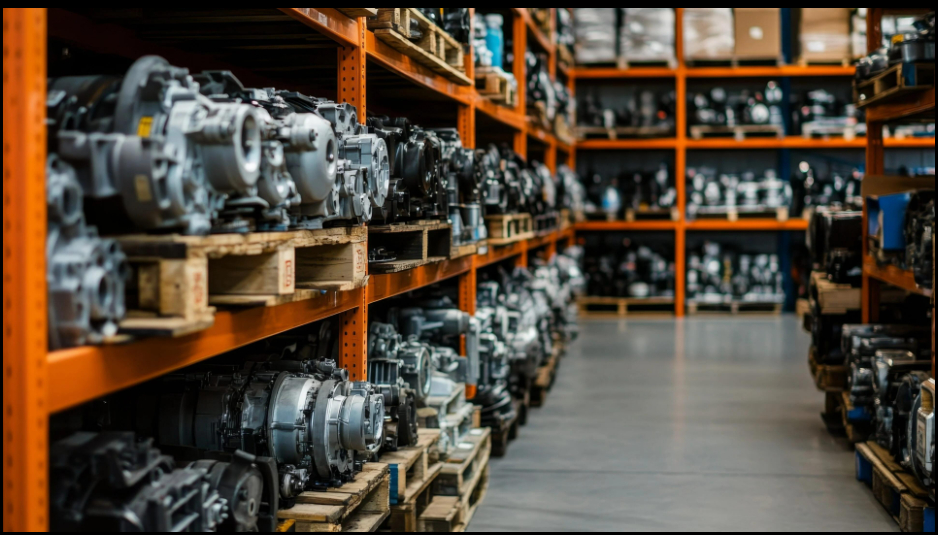
Home Resources Scaling Automotive Parts Data & Improving ROAS with a PIM-Led Commerce Architecture Scaling Automotive Parts Data & Improving ROAS with a PIM-Led Commerce Architecture Operationalized complex product data to drive scalable eCommerce growth and improved marketing efficiency Client Overview Manufacturer and distributor of premium OEM 4×4 automotive parts and tools, specializing in hard-to-find components. With a catalog spanning complex parts, fitment data, and technical documentation, the company relies heavily on its eCommerce channel to serve a niche but demanding customer base. Tech Stack Platforms TruPIM Shopify Fishbowl ERP Integrations ERP ? TruPIM TruPIM ? Shopify Shopify ? Google Merchant Center 1. The Problem As the company scaled its product catalog and digital operations, Shopify alone was not sufficient to manage the complexity of automotive parts data—particularly fitment relationships and hierarchical category structures. Key challenges included: Difficulty modeling and managing vehicle fitment data within Shopify Inefficient handling of product hierarchies and fitment-specific technical notes High manual effort required to maintain and update catalog data Underperforming Google Shopping campaigns due to unoptimized product feeds 2. What Was Holding Them Back Lack of a centralized system to manage and govern product and fitment data Rigid data structures in Shopify and Fishbowl ERP limiting scalability Manual, error-prone catalog management workflows Limited control over how product data was structured and syndicated across channels 3. What They Needed Centralized PIM system for product, fitment, and category data Automated data flows between ERP, PIM, and Shopify Scalable way to manage complex fitment relationships Improved product data quality for Google Merchant Center feeds Reduced manual effort in catalog management and updates 4. How We Solved It StrikeTru designed and implemented a PIM-led commerce architecture to centralize and operationalize the company’s product data across systems. At the core of the solution was a centralized PIM system that unified: Product data Vehicle fitment relationships Fitment-specific technical notes Product hierarchy and category structures This approach enabled business users to manage all catalog data in a single system, with full visibility and control over data structures, enrichment workflows, and syndication rules. To streamline data flow and eliminate manual effort: An ERP-to-PIM integration automated the ingestion of base product data A configurable PIM-to-Shopify connector enabled near real-time synchronization of product, pricing, and category data Data governance rules and automations were implemented to standardize and scale catalog operations Critically, StrikeTru introduced data automation workflows that significantly reduced manual intervention, including: Automated product categorization and hierarchy assignment Auto-assignment of ancestor categories to improve on-site search Fitment assignment logic based on category relationships To address the complexity of automotive fitment data, the solution leveraged Shopify metafields to power a scalable Year-Make-Model (YMM) experience: Fitment data could be synced as structured key-value pairs, labels, or short codes The architecture supports syncing over 60,000 fitments per product, enabling scalability for highly complex catalogs This PIM-first approach ensured that Shopify functioned as a high-performance storefront, while PIM handled the complexity of data modeling, enrichment, and governance. 5. The Impact Before StrikeTru Manual product onboarding and updates No scalable fitment management Limited category structure in Shopify Inconsistent product content High operational complexity After StrikeTru Significant reduction in time spent managing product catalog and fitment data Improved scalability of automotive parts data operations Enhanced on-site search and product discovery through better category and fitment structuring Higher quality product data feeds for Google Merchant Center, contributing to improved ROAS Greater control and visibility over product data, enabling faster updates and iteration 6. Why It Matters For automotive and other complex B2B catalogs, commerce success is tightly coupled with how well product data is structured, governed, and activated across channels. By implementing a PIM-led architecture, the company transformed product data from a bottleneck into a strategic asset—enabling: Scalable catalog growth without proportional operational overhead More effective digital merchandising and search experiences Improved marketing performance driven by high-quality product data This engagement highlights StrikeTru’s ability to design and implement data-centric commerce architectures that go beyond platform limitations—helping clients scale efficiently while delivering superior customer experiences. Modern Commerce Starts with Better Product Data We design commerce-first product data foundations that scale across channels, systems, and customer experiences. Schedule a Strategy Call Product Syndication Read More Success Stories
How an Powersports Dealer Modernized From Fragmented Product Data to Scalable Powersports Commerce

Home Resources How an Powersports Dealer Modernized From Fragmented Product Data to Scalable Powersports Commerce How a Powersports Dealer Modernized From Fragmented Product Data to Scalable Powersports Commerce Streamlined management of 1.5M + OEM & after-market auto parts, fitment, price, availability, & inventory data in Akeneo PIM & Adobe Commerce for a modern powersports commerce site. Powersports Dealer at a Glance Leading multi-line, full-service powersports dealership Sells a comprehensive list of parts and accessories Complex OEM and aftermarket parts and fitment data Multiple providers of product, pricing, and inventory data Frequent, high-volume data sync requirements for commerce site Tech Stack Platforms Akeneo PIM Adobe Commerce Powersports catalog data provider OEM supplier portals Powersports distributor portals Integrations ARINet ? Akeneo OEM supplier portals ? Adobe Commerce Western / Tucker / Parts Unlimited ? Akeneo Western / Tucker / Parts Unlimited ? Adobe Commerce Akeneo ? Adobe Commerce 1. The Problem Powersports Dealer needed to navigate a highly fragmented automotive commerce environment where large amounts of product, digital asset, pricing, inventory, and fitment data had to be regularly onboarded onto its Adobe Commerce site from many data sources including ARINet (a data provider), OEMs, and distributors. This data needed to be onboarded, organized, enriched, governed, and updated in Adobe Commerce at scale on a daily basis. This was simply not easy to do in Adobe Commerce without incurring significant incremental operating costs and without risking site downtime. 2. What Was Holding Them Back The constraints were architectural rather than tactical. Powersports Dealer faced several structural challenges activating its catalog for commerce: Multiple data sources and formats Frequent updates – price, inventory, and other Inconsistent fitment and compatibility data Ongoing reconciliation & enrichment – price, inventory, titles, fitments, variants, etc Complexity onboarding catalog data into Adobe Commerce Poor data management and automation features in Adobe Commerce Frequent, high-volume data operations that affect site performance and uptime Commerce tightly coupled with fragmented source systems The result would have been operational friction, low velocity enrichments, and limited scalability. 3. What They Needed Powersports Dealer needed a data and commerce infrastructure built for agility and scale. A governed, single source of truth for product information (i.e. a PIM) Sophisticated eCommerce product data management capabilities Automated aggregation and harmonization of parts and fitment data Automated enrichments and reconciliations Seamless data integration with Adobe Commerce website Reliable, daily price and inventory syncs They needed to recognize and invest in a PIM for Adobe Commerce solution, and not view this as simply a commerce platform data migration project. 4. How We Solved It StrikeTru designed a centralized, automation-heavy product ecosystem centered around Akeneo PIM Community Edition. eCommerce PIM Foundation Structured and normalized product data from ARINet, multiple OEMs and distributors Established Akeneo PIM as the authoritative product enrichment layer Orchestrated frequent parts, fitment, price, and inventory updates Designed future state product data structures – family, variant, & attribute models Implemented governance controls to ensure high quality data Automated data enrichment (e.g.customer friendly titles, price calcs) This transformed disparate product records into governed, commerce-ready assets. Intelligent Automation Framework To reduce manual effort and drive operational benefits, we implemented targeted automation frameworks: Parts Data Normalization Automated onboarding of OEM and aftermarket parts and fitment data sets Harmonized and enriched parts data from multiple sources Improved data quality and consistency Fitment & Compatibility Automation Centralized fitments and product to fitment compatibility data Improved fitment data consistency and reliability Inventory & Pricing Synchronization Automated synchronization of price and inventory feeds Reduced manual update cycles and operational lag Improved downstream commerce data accuracy These automations improved parts data integrity, reduced operational friction, and increased catalog scalability. Integration Engineering & Commerce Enablement Multi-Source Product Data Orchestration The integration layer was engineered for scalability, governance, and synchronization transparency. Normalized data ingestion from ARINet, OEMs, and top distributors Centralized transformation and enrichment inside Akeneo Controlled synchronization into Adobe Commerce environment Efficient handling of inventory, pricing, availability, and fitment updates This eliminated fragmented enrichment workflows while improving data sync reliability. Adobe Commerce Enablement Delivered enriched, commerce-ready product data into Adobe Commerce Provided support for product discovery (including YMM search) on the website Improved catalog consistency and downstream presentation quality Enabled scalable support for future commerce expansion Governance, Testing & Operational Readiness Formal QA, UAT, and hypercare processes Structured migrations and rollout Operational validation across integrations and commerce workflows Monitoring and reconciliation support during deployment The implementation was engineered for long-term operational stability — not short-term deployment success. 5. The Impact Powersports successfully launched a modern, Adobe Commerce based powersports commerce store backed by a high SKU count catalog data infrastructure powered by Akeneo PIM and designed for governance, automation, and easy enrichment. Planning a PIM or Commerce Transformation? Build a scalable, governed product ecosystem designed for long-term growth. Schedule a Strategy Call Read More Success Stories
Commerce Experience Synchronization from Akeneo to Shopify
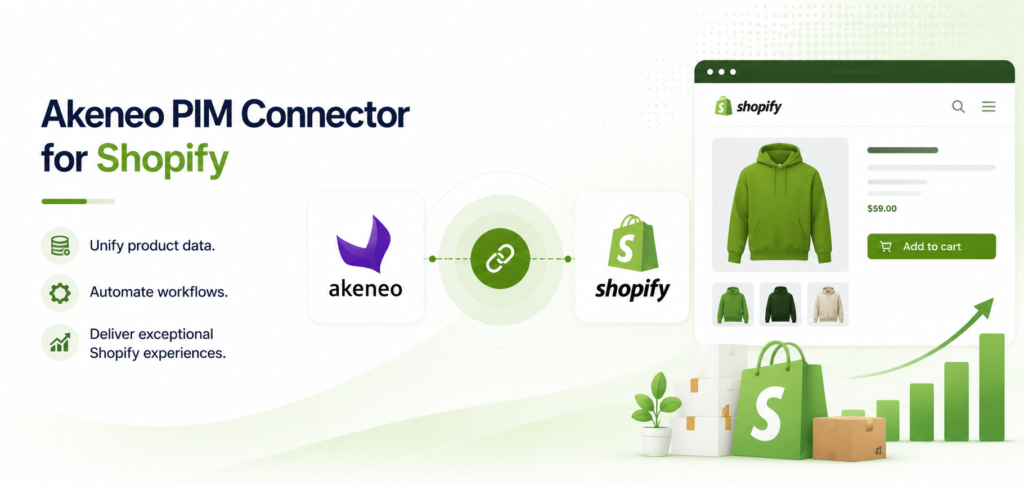
Home Resources Commerce Experience Synchronization from Akeneo to Shopify Commerce Experience Synchronization from Akeneo to Shopify Synchronize collections, products, variants, media, metafields, metaobjects, fitments, bundles, promotions, and more without custom development. Connector at a Glance Business-user friendly, no-code integration Compatible with all Akeneo & Shopify editions Supports new and existing Shopify catalogs Multi-language, multi-store, Markets, and B2B catalog support On-demand, scheduled, and near real-time syncs High performance, supporting catalogs from 500 to 1M+ SKUs Monitoring, reporting, and notifications via Email, Slack, and Microsoft Teams Tech Stack Platforms Shopify Akeneo PIM Integrations Akeneo PIM ? Shopify Proven Across Industries and Commerce Setups Whether you’re managing fitment-heavy automotive catalogs, rich furniture assortments, technical industrial products, regulated healthcare catalogs, or multi-store retail operations, the Akeneo Shopify Connector provides the flexibility to support complex commerce requirements without custom middleware. Customers Using the Connector 1. The Problem As Shopify commerce operations grow, synchronization complexity grows with it. Instead of launching new assortments and driving revenue, commerce teams were spending time managing data movement and catalog operations. Organizations needed to support: Complex product data & relationships Technical specifications and documentation Personalized product experiences Additional data structures (fitments, swatches, size matrices, etc.) Dynamic promotions and merchandising Multi-store, Markets, and B2B operations Most were managing this through manual processes or custom integrations requiring ongoing IT involvement. The result was slower execution, inconsistent experiences, and unnecessary operational effort. 2. What Was Holding Them Back Heavy reliance on custom integrations and manual processes Ongoing dependency on developers for merchandising and catalog changes Difficulty delivering advanced commerce experiences inside Shopify Limited support for advanced commerce use cases at scale Whether it was fitment data, bundles, B2B catalogs, multi-store operations, or personalized product experiences, many requirements still depended on custom development. As catalogs and storefronts expanded, effort increased alongside them. 3. What They Needed Organizations needed more than a connector. They needed a reliable commerce synchronization framework capable of supporting modern Shopify experiences at scale. Requirements included: Automated synchronization between Akeneo and Shopify Support for advanced Shopify data structures Multi-store, Markets, and B2B operations Flexible mappings and smart transformations Reduced dependency on development teams Faster merchandising execution Better governance and visibility The goal was simple: enable richer commerce experiences without increasing complexity. “Modern commerce runs on product data, but product data only creates value when it reaches the storefront accurately, consistently, and at scale. We built this connector to help organizations turn product data into better commerce experiences without the overhead of custom integrations.” Vik Gundoju, Principal Consultant & CEO, StrikeTru 4. How We Solved It StrikeTru implemented the Akeneo Shopify Connector as a no-code synchronization platform that connects Akeneo and Shopify at scale. Automated Commerce Operations The connector automates synchronization of products, variants, collections, media, pricing, inventory, SEO data, Shopify Markets, and B2B catalogs. Faster launches and streamlined catalog operations. Advanced Commerce Experiences Organizations use the connector to power compatibility data, product relationships, bundles, technical content, personalized product experiences, and structured PDPs. Supporting everything from automotive fitments to furniture collections, apparel swatches, and other relationship-driven commerce experiences. Richer buying experiences without custom development. Merchandising & Growth Enablement The connector helps teams manage collection hierarchies, navigation structures, promotions, campaigns, and market-specific content directly from Akeneo. Greater merchandising control with less developer dependency. Governance & Scale Built-in monitoring, logging, notifications, flexible mappings, and support for multi-store environments enable organizations to scale catalog operations confidently. For example, a heavy-duty truck parts business required advanced fitment data management, sub-collection metafield synchronization, and technical documentation synchronized through Shopify metaobjects. A healthcare retailer required structured product information and enriched catalog governance across a growing product catalog. These use cases were addressed within the same connector framework without requiring separate integration solutions. Organizations could focus on growth initiatives instead of synchronization management. 5. The Impact Organizations using the Akeneo Shopify Connector achieved measurable improvements across catalog operations, merchandising, and commerce execution. Before StrikeTru Manual catalog operations Heavy IT dependency Slow merchandising execution Limited scalability After StrikeTru Automated Akeneo-to-Shopify synchronization Faster launches and catalog updates Richer commerce experiences Simplified multi-store operations Reduced operational overhead Focus on growth, not synchronization. Ready to Simplify Akeneo-to-Shopify Operations? Launch faster, reduce manual effort, and scale commerce with a no-code connector. Schedule a Strategy Call Learn More Read More Success Stories
Enterprise Catalog Synchronization from Akeneo to BigCommerce
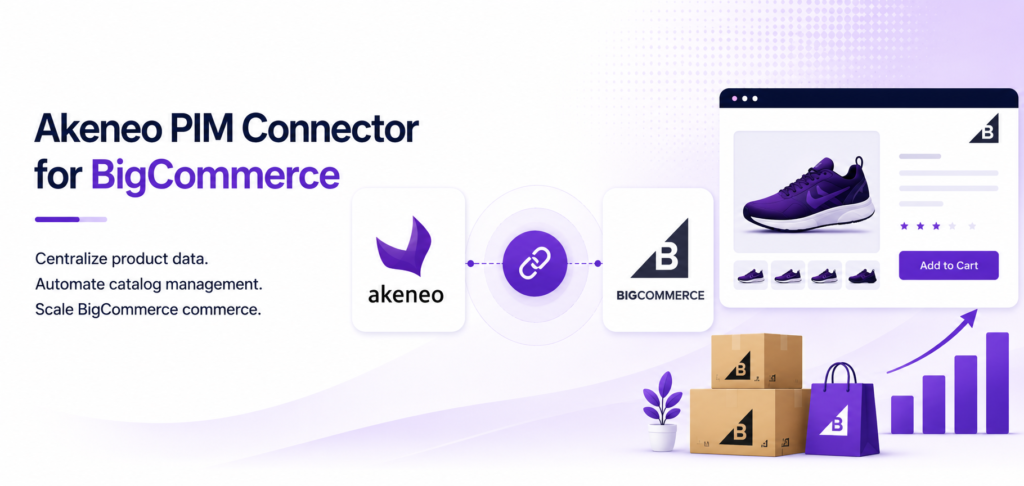
Home Resources Enterprise Catalog Synchronization from Akeneo to BigCommerce Enterprise Catalog Synchronization from Akeneo to BigCommerce Synchronize products, categories, brands, variants, modifiers, custom fields, metafields, storefront assignments, relationships, and other structured product data across BigCommerce without custom development. Connector at a Glance Business-user friendly, no-code integration Compatible with all Akeneo & BigCommerce editions Supports new and existing BigCommerce catalogs Multi-Storefront and B2B-ready On-demand, scheduled, and near real-time syncs Intelligent mappings and data transformations Monitoring, reporting, and notifications via Email, Slack, and Microsoft Teams Proven with catalogs exceeding 100K SKUs and 250K+ images Akeneo-Certified Connector | App of the Month 2025 Tech Stack Platforms BigCommerce Akeneo PIM Integrations Akeneo PIM ? BigCommerce Proven Across Industries and Commerce Setups Whether you’re managing automotive catalogs, industrial products, building materials, furniture assortments, or B2B commerce operations, the Akeneo BigCommerce Connector provides the flexibility to support complex catalog structures without custom middleware. Customers Using the Connector 1. The Problem As BigCommerce commerce operations grow, catalog complexity grows with it. Instead of launching new products, storefronts, and customer experiences, commerce teams were spending time managing integrations, catalog updates, and data consistency across systems. Organizations needed to support: Multi-Storefront catalog operations Complex category hierarchies and navigation structures Product relationships, kits, and bundles Compatibility and reference data Technical specifications and documentation B2B and account-specific catalog requirements Large-scale product updates Most were managing this through manual processes or custom integrations requiring ongoing IT involvement. The result was slower execution, inconsistent experiences, and growing operational overhead. 2. What Was Holding Them Back Heavy reliance on custom integrations and manual processes Ongoing dependency on developers for catalog and storefront changes No support for Multi-Storefront catalog governance Difficulty operationalizing complex catalog structures at scale Whether it was storefront-specific category trees, compatibility data, product relationships, merchandising content, or B2B catalog requirements, many use cases still depended on custom development. As catalogs expanded, effort increased alongside them. 3. What They Needed Organizations needed more than a connector. They needed a scalable catalog operations framework capable of supporting modern BigCommerce commerce environments. Requirements included: Automated synchronization between Akeneo and BigCommerce Multi-Storefront catalog management Flexible mappings and intelligent data transformations Advanced category, brand, and relationship synchronization Reduced dependency on development teams Faster merchandising execution Better governance and operational visibility The goal was simple: manage increasingly complex catalogs without increasing operational complexity. “The question isn’t whether product data can reach BigCommerce. The question is whether your team can manage thousands of products, multiple storefronts, and ongoing business changes without creating more work. That’s the problem we set out to solve.” Vik Gundoju, Principal Consultant & CEO, StrikeTru 4. How We Solved It StrikeTru implemented the Akeneo BigCommerce Connector as a no-code synchronization platform purpose-built for enterprise catalog operations. Complex Catalog Management Organizations use the connector to synchronize: Products, variants, modifiers, categories, and brands Images, videos, documents, and other digital assets Custom fields, metafields, and structured reference data Storefront-specific catalog assignments and category trees Category & Brand metadata including descriptions, images, URLs, and SEO data Product relationships, accessories, kits, and bundles Compatibility and reference data Structured data for downstream commerce systems A complete catalog, synchronized from a single source of truth. Intelligent Catalog Transformations Organizations use the connector to: Transform data for custom fields, metafields, variant options Convert PIM-friendly data into commerce-ready values automatically Configure variant option display types Configure custom metafield namespaces to control PDP experiences More control. Less customization. Enterprise Governance & Scale Built-in monitoring, logging, notifications, filtering rules, and recovery tools help teams manage large catalogs confidently. The connector also supports advanced catalog management requirements including: Image sequencing and media control Automatic removal of obsolete values and assets Existing catalog synchronization and updates Large-scale catalog processing Successfully proven with: 100K+ SKUs, 250K+ images, and 75+ attributes synchronized in as little as 6–8 hours Built for enterprise catalog operations. 5. The Impact Organizations using the Akeneo BigCommerce Connector achieved measurable improvements across catalog management, merchandising, and storefront operations. Before StrikeTru Manual catalog operations Heavy IT dependency Slow storefront updates Limited Multi-Storefront governance High operational complexity After StrikeTru Automated Akeneo-to-BigCommerce synchronization Centralized Multi-Storefront management Faster catalog launches and updates Richer commerce experiences Reduced operational overhead Scale catalogs, not complexity. Ready to Simplify BigCommerce Catalog Operations? Centralize catalog management, automate storefront operations, and scale Multi-Storefront commerce with the Akeneo BigCommerce Connector. Schedule a Strategy Call Learn More Read More Success Stories
BigCommerce V2-V3 Migration Made Easy!
Home Events BigCommerce V2-V3 Migration Made Easy! BigCommerce V2-V3 Migration Made Easy! Learn how StrikeTru helped Whisker Seeker migrate to BigCommerce V3. Event Details Thinking of MANUALLY migrating your BigCommerce store from V2 to V3? This can be complicated, tedious, costly, and disruptive to your business. Do it seamlessly through an app! Hear from Whisker Seeker as they share their journey of how they migrated their stores to BigCommerce V3 through StrikeTru’s V2-V3 Product Migration App. Learn how they automated their migration and updated their stores quickly to take advantage of better features in V3 such as MSF, MLI, APIs, metafield visibility, and more! Wednesday, June 28, 2023 10:00 AM – 11:00 AM CST Virtual Zoom Event What we’ll talk about: Why the need to migrate from V2 to V3? What was the process to migrate? What are the results? What are some best practices to consider when migrating? Watch The Webinar Please fill the form below and describe your request. Our team will contact you shortly. IndustryManufacturingRetailDistributionTechnologyOther Watch Now ?
Elevate Your Tech Stack Now!

Home Events Elevate Your Tech Stack Elevate Your Tech Stack Learn How To Take Control Of Your Product Data To Sell More, And Faster. Event Details Successful companies want to quickly respond to fast changing markets and customer demands, so they are looking for ways to modernize their eCommerce by better managing their product data. Having apps and tools that are seamless across every touchpoint is vital in creating a happy customer. Hear from StrikeTru’s Co-Founder & Commerce Expert, Vik Gundoju as he shares how you can elevate your tech stack by implementing one or more of these apps and tools for your BigCommerce store(s): BigCommerce V2-V3 Product Migration App BigCommerce Multi-Storefront Migration Service BigCommerce to Akeneo PIM Catalog Migration Tool Wednesday, October 26, 2022 10:00 AM – 11:00 AM CST Virtual Zoom Event What we’ll talk about: What is it? What is it solving for? How does it work? What is the connection with other apps/tools? Watch The Webinar Please fill the form below and describe your request. Our team will contact you shortly. Industry ManufacturingRetailDistributionTechnologyOther Watch Now ?
Talk MDM To ME

Home Events Talk MDM To Me Talk MDM To Me Learn about MDM strategy & best practices for a 360 data view of your business. Event Details Have you ever come across situations where customer data may not be identical in order entry, shipping and customer service systems due to variations in names, addresses or other attributes? These issues can also apply to product data and other types of information. It all boils down to a “single source of truth” or “single version of truth.” It’s all about master data management (MDM) in organizations. MDM systems are a must in organizations if you are looking to improve business results or eliminate operating pains. In today’s world, it’s more important than ever to understand the ins-and-outs of master data management so your company can reap the benefits of good data management and grow sales, lower costs, reduce risks, and meet compliance needs. In addition to having a single-source/version of truth, defining ownership of data or data governance is just as critical. Both complement each other and are needed to effectively manage and use data. High-quality data and clarity of data ownership helps contribute to operational efficiencies that impact your bottom line. Hear from our very own Harry Singh and Vik Gundoju, managing partners and co-founders of StrikeTru as they provide a practitioner’s insights on these questions and more. Wednesday, May 25, 2022 10:00 AM – 10:30 AM CST Virtual Zoom Event What we’ll talk about: What is MDM and Data Governance? Why do companies implement MDM systems? What are key features of a MDM System? What are some best practices in implementing MDM solutions? Watch The Webinar Please fill the form below and describe your request. Our team will contact you shortly. IndustryManufacturingRetailDistributionTechnologyOther Watch Now ?
Coffee & Commerce with Richmond Supply
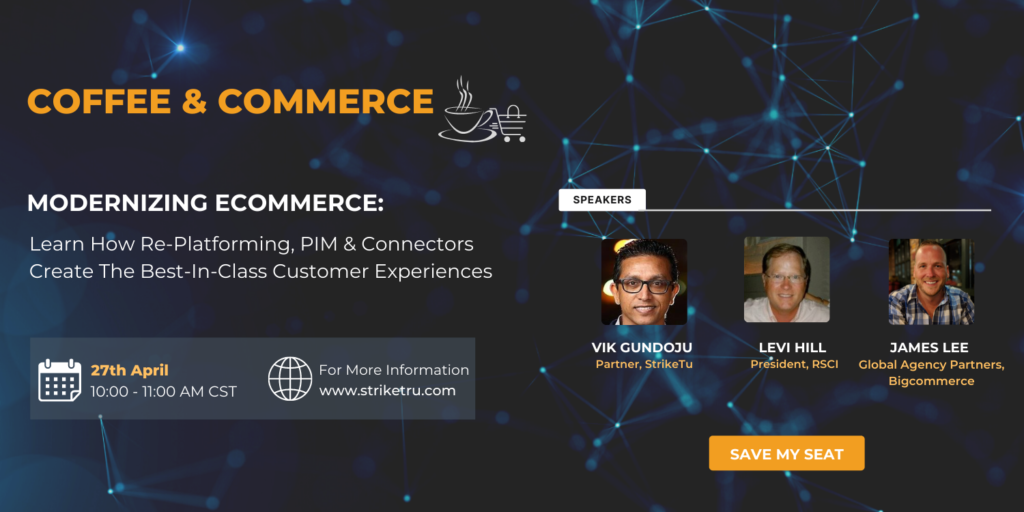
Home Events How PIM and DAM Powered a Multi-Site Commerce Transformation at BrickWorks MODERNIZING ECOMMERCE Learn How Re-Platforming, PIM & Connectors Create The Best-In-Class Customer Experiences Event Details Successful companies respond quickly to fast changing markets and customer demands. To do that, they must modernize their eCommerce environments and improve operating efficiencies. Delivering brand and product content that is seamless across every touchpoint is vital to creating exceptional customer experiences. The ability to do that at scale is critical to driving growth. Hear from commerce experts and industrial supplier Richmond Supply as they share their journey of how they modernized eCommerce through re-platforming and by implementing a PIM and Data Connectors. Wednesday, April 27, 2022 10:00 AM – 11:00 AM CST Virtual Zoom Event What we’ll talk about: Why did Richmond Supply modernize their eCommerce? How did StrikeTru & BigCommerce resolve Richmond Supply’s core tech and data issues? What are the results? What are some best practices to consider when modernizing an eCommerce tech stack? Watch The Webinar Please fill the form below and describe your request. Our team will contact you shortly. IndustryManufacturingRetailDistributionTechnologyOther Watch Now ? Guest Speakers Vik Gundoju Partner, StrikeTru Levi Hill President, Richmond Supply James Lee Senior Sales Engineer, Bigcommerce
Double Down on Ecommerce Growth

Home Events Double Down on Ecommerce Double Down on Ecommerce Learn The Best Practices of Integration PIM and DAM Event Details Successful multichannel commerce demands automated and near real-time access to and distribution of digital assets tightly layered with product metadata. Delivering brand & product content that is seamless across every touchpoint is vital to creating deeply engaging customer experiences. When implemented properly, the benefits of combining these two solutions represents enormous potential for an online business. Jump in on the conversation as we exchange views on a best-practice based approach crystallized from several implementation projects, that will make for a smoother, more scalable integration. Acquaint yourselves with StrikeTru’s founders & subject matter experts on our first ever practitioner-led Zoom open house, as they deliberate over integrating PIM and DAM, how clients can break out of digital sameness and get in front of the competition. Thursday, February 24, 2022 10:00 AM – 10:30 AM CST Virtual Zoom Event What we’ll talk about: How are ecommerce product data and digitals assets typically managed today? What are some challenges associated with current product data and asset management approaches? Why do store owners need PIM and DAM? Why should you integrate them? What are some best practices in integrating PIM and DAM systems? Watch The Webinar Please fill the form below and describe your request. Our team will contact you shortly. IndustryManufacturingRetailDistributionTechnologyOther Watch Now ? Guest Speakers Vik Gundoju Partner, StrikeTru Levi Hill President, Richmond Supply James Lee Senior Sales Engineer, Bigcommerce