Educational Content & Discoverability Signals: Turning Product Data into Customer Knowledge
Finding the right part is only half the conversation.
Imagine a customer searching for low-noise brake pads for a 2021 Ford F-150 with a towing package.
An AI-powered search engine quickly identifies the correct brake pad by understanding vehicle compatibility, fitment relationships, and product attributes.
Problem solved?
Not quite.
The customer’s next questions rarely revolve around compatibility. Instead, they begin asking questions that product data alone can’t answer:
- Can I install these brake pads myself?
- Do I need to replace the rotors too?
- What tools will I need?
- Why were my old brake pads squealing?
- Is there a bedding-in procedure after installation?
This is where many AI experiences begin to break down.
The product has already been identified, but the AI lacks the knowledge required to guide the customer through the rest of their journey.
That’s where Educational Content and Discoverability Signals become essential. Together, they enable AI not only to recommend the right part but also to explain it, support it, and surface trusted information exactly when customers need it.
Product Data Identifies. Educational Content Explains.
Let’s stay with our brake pad example.
The AI has already determined the correct product for the customer’s vehicle.
The next question arrives:
Can I install these brake pads myself?
This isn’t a fitment question anymore.
It’s a knowledge question.
The answer doesn’t exist in the product title or specifications. Instead, it lives in installation guides, service documentation, troubleshooting articles, FAQs, maintenance recommendations, and technical bulletins.
Without access to this knowledge, AI can only provide generic responses.
With structured educational content, it can deliver answers that are accurate, relevant, and grounded in trusted documentation.
In simple terms:
Product data tells AI what the product is. Educational content teaches AI how to explain it.
Educational Content Becomes the AI's Knowledge Base
Many organizations treat educational content as an afterthought—PDF manuals stored in a document repository or FAQs published separately from product pages.
For AI, these resources are far more valuable.
They form the knowledge layer that supports customer conversations.
This includes content such as:
- Installation guides
- Repair procedures
- Troubleshooting documentation
- Frequently Asked Questions
- Maintenance recommendations
- Warranty information
- Product comparison guides
- Technical service notes
The real value comes from connecting this content directly to the products it supports.
Instead of existing as isolated documents, each knowledge asset should be linked to the relevant part, vehicle fitments, and related components.
For our brake pad example, the product could be associated with:
Brake Pad
│
Installation Guide
Brake Pad
│
Rotor Inspection Guide
Brake Pad
│
Brake Noise Troubleshooting
Brake Pad
│
Torque Specifications
Brake Pad
│
Warranty Information
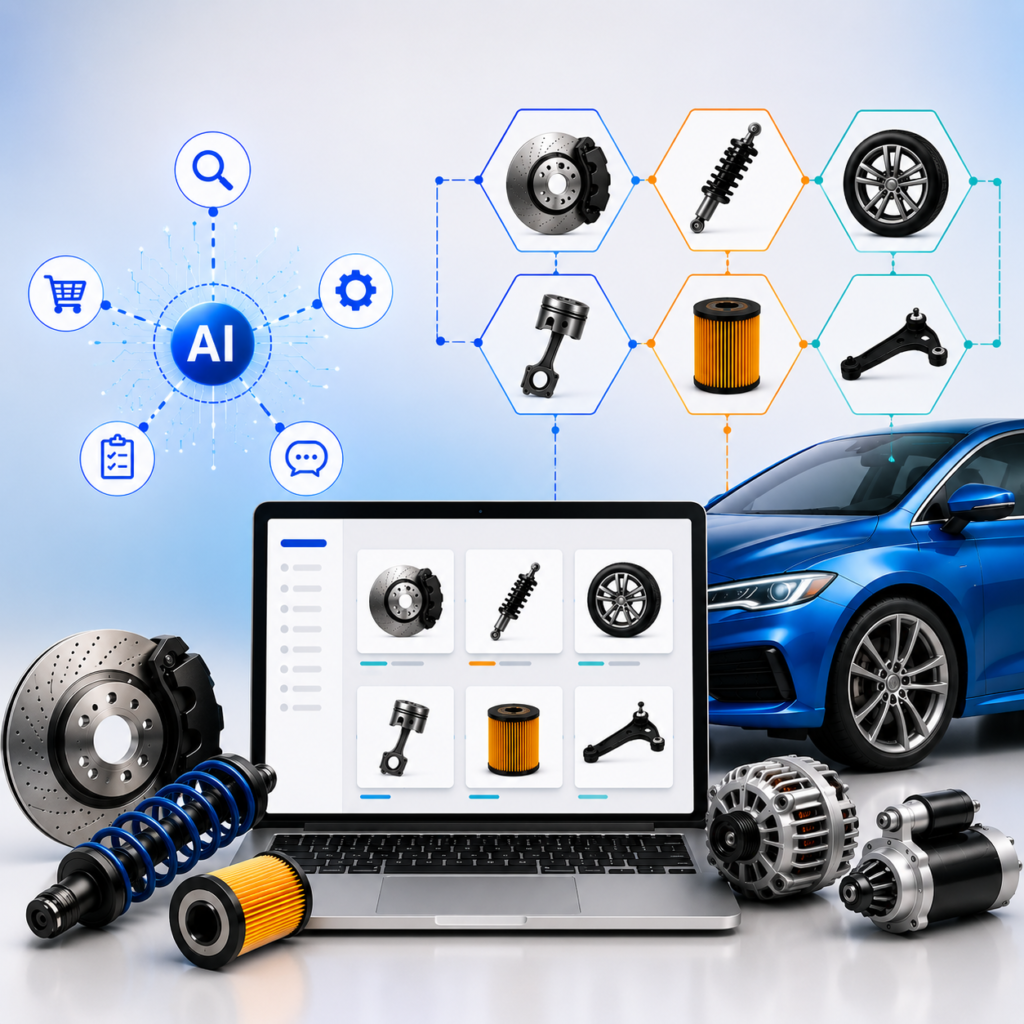
Rather than retrieving a single product page, AI now retrieves an entire knowledge ecosystem surrounding that brake pad.
AI Can Guide, Not Just Recommend
Now, consider how the customer journey unfolds.
The customer asks:
Should I replace the rotors at the same time?
Instead of generating a generic answer, the AI retrieves information linked to that specific brake pad and vehicle configuration.
It may explain that:
- Rotor thickness should be measured against the manufacturer’s minimum specification.
- Rotors showing excessive scoring or heat damage should be replaced.
- New ceramic brake pads require a proper bedding-in procedure.
- An installation hardware kit is recommended for optimal braking performance.
Notice the difference.
The AI isn’t simply suggesting products.
It’s helping the customer make an informed repair decision using verified technical knowledge.
That creates confidence—something product specifications alone cannot achieve.
Discoverability Signals: Helping AI Find the Right Knowledge
Even the best educational content has limited value if AI systems can’t find or understand it.
This is where discoverability signals come into play.
As AI-powered search becomes increasingly conversational, success depends on making content understandable not just for people, but for machines as well.
For our brake pad example, discoverability signals might include:
- Product Schema
- FAQ Schema
- HowTo Schema
- Structured metadata
- Clear internal linking between products and supporting documentation
- Logical content hierarchies
- Canonical URLs
These signals help AI recognize that the product page, installation guide, troubleshooting article, and FAQ all describe the same brake pad and should be used together when answering customer questions.
Rather than searching across disconnected documents, AI can confidently assemble a complete response from trusted sources.
Beyond Traditional SEO
Traditional SEO focused on helping customers find webpages.
AI discoverability focuses on helping machines understand knowledge.
As customers increasingly rely on conversational AI and generative search experiences, organizations must think beyond keywords and rankings.
Questions worth asking include:
- Can AI identify what this document is about?
- Is the installation guide connected to the correct product?
- Are FAQs linked to the appropriate vehicle fitments?
- Can AI distinguish between general maintenance advice and vehicle-specific instructions?
When content is structured in this way, AI doesn’t simply retrieve information—it understands the context in which that information should be used.
Bringing Everything Together
Let’s return to our customer.
They ask:
I’m looking for low-noise brake pads for my 2021 Ford F-150 with a towing package. Can I install them myself, and should I replace the rotors too?
A well-prepared AI system can now respond with confidence.
- It identifies the correct brake pad.
- It confirms compatibility.
- It retrieves the installation guide.
- It explains the bedding-in procedure.
- It recommends inspecting the rotors against manufacturer specifications.
- It highlights the required tools.
- It references relevant warranty information.
Most importantly, every response is grounded in structured product knowledge and trusted educational content—not generic AI assumptions.
The interaction feels less like searching a catalog and more like consulting an experienced technician.
How StrikeTru Helps
At StrikeTru, we help automotive manufacturers, distributors, and aftermarket suppliers build AI-ready product experiences that extend beyond catalog management.
Our approach includes:
- Structuring educational content for AI consumption.
- Connecting technical documentation to products and vehicle fitments.
- Implementing discoverability strategies using structured metadata and schema.
- Preparing knowledge assets for Retrieval-Augmented Generation (RAG) and conversational AI.
- Building AI-ready content architectures that improve product discovery and customer support.
The result is a product catalog that doesn’t just help AI identify the right part—it enables AI to educate, guide, and build customer confidence throughout the entire buying and ownership journey.
Conclusion
Identifying the correct part is only the beginning of an AI-driven customer experience.
Customers expect answers that go beyond compatibility. They want guidance on installation, maintenance, troubleshooting, and best practices—all delivered in context.
Educational content provides the knowledge AI needs to answer those questions, while discoverability signals ensure that knowledge can be found, interpreted, and trusted.
- Product → Vehicle Configuration
- Product → Fitment Rules
- Product → Technical Notes
- Product → Installation Procedures
- Product → Accessories
- Product → Alternate Parts
- Product → OEM References
- Product → Certifications
Together, these capabilities transform an automotive parts catalog from a collection of product records into an intelligent knowledge ecosystem—one that enables AI to recommend the right part, explain it with confidence, and support customers long after the search is complete.